Liraglutide (Saxenda, Victoza)
Summary: Liraglutide is the original once-daily GLP-1 receptor agonist, sold as Victoza for type 2 diabetes and Saxenda for chronic weight management, with about 8% mean weight loss in the SCALE obesity trial and a confirmed cardiovascular benefit from LEADER. A generic version reached the U.S. market in December 2024.
This content is for informational purposes only and is not medical advice. Always consult a qualified healthcare provider before starting, changing, or stopping any medication.
What liraglutide is
Liraglutide is a glucagon-like peptide-1 (GLP-1) receptor agonist made by Novo Nordisk. It is a peptide that mirrors human GLP-1 with one amino acid swap and a fatty acid side chain that lets it bind albumin in the bloodstream. That binding slows clearance and gives the drug a plasma half-life of roughly 13 hours, which is long enough for once-daily injection but much shorter than the ~165 hours of semaglutide. [1]
It is sold under two brand names. Victoza is approved for type 2 diabetes and was cleared by the FDA in January 2010. Saxenda is the same molecule at a higher dose, approved in December 2014 for chronic weight management in adults with obesity or with overweight plus a weight-related condition such as hypertension or sleep apnea. A combination product called Xultophy pairs liraglutide with insulin degludec for diabetes. [1][2]
Liraglutide was the second GLP-1 agonist to reach the U.S. market after exenatide and was a structural step forward. The molecule shares 97% sequence homology with native human GLP-1, has a molecular weight of about 3,751 daltons, and was developed at Novo Nordisk by a team led by Lotte Bjerre Knudsen during the late 1990s. The drug carried Novo into the modern obesity era and built the commercial template that semaglutide would scale. [1]
Chemistry and how the molecule was engineered
Native GLP-1 has a half-life of one to two minutes because the enzyme dipeptidyl peptidase-4 (DPP-4) clips off the first two amino acids almost immediately. Liraglutide solves that problem in two ways. First, the lysine at position 34 of native GLP-1 is replaced with arginine, which removes one of the protease cleavage handles. Second, a 16-carbon palmitic acid chain is attached to the lysine at position 26 through a glutamic acid linker. That fatty acid tail binds reversibly to serum albumin, which both shields the peptide from DPP-4 and slows renal clearance. The result is a molecule with a half-life roughly 800 times longer than native GLP-1. [1]
Subcutaneous absorption is slow and steady. Peak plasma concentrations arrive 8 to 12 hours after injection, absolute bioavailability sits near 55%, and protein binding exceeds 98%. The drug is metabolized like any large peptide, broken into amino acid fragments through endogenous proteases rather than processed by liver cytochromes, which is why dose adjustments for hepatic or renal impairment are limited. [1][3]
How it works in the body
Like other GLP-1 agonists, liraglutide stimulates glucose-dependent insulin secretion from pancreatic beta cells, suppresses glucagon when blood sugar is normal or high, slows gastric emptying, and acts on hypothalamic appetite circuits to reduce hunger. The glucose-dependent mechanism is why monotherapy carries low hypoglycemia risk outside of combinations with sulfonylureas or insulin. [1][3]
The 13-hour half-life is the central design choice that distinguishes liraglutide from the weekly drugs. Daily dosing produces a relatively flat steady-state exposure once titration is complete, but missing more than three days requires restarting the titration. By contrast, semaglutide and tirzepatide stay in circulation for roughly a week per dose. [1][4]
The appetite signal is mediated by GLP-1 receptors on neurons in the arcuate nucleus and area postrema. Functional MRI studies in liraglutide-treated patients show reduced activation in reward-related brain regions when subjects view high-calorie food images, which lines up with self-reported reductions in cravings and food preoccupation. The gastric emptying effect is meaningful early in treatment but tachyphylaxes within weeks, so the steady-state appetite signal does most of the long-term work. [1][4]
The two brands and their indications
Victoza launched in January 2010 as the second GLP-1 agonist on the U.S. market. The original adult indication was type 2 diabetes as an adjunct to diet and exercise. In August 2017, the FDA added a cardiovascular indication based on the LEADER trial, allowing Victoza to be used to reduce the risk of major adverse cardiovascular events in adults with type 2 diabetes and established cardiovascular disease. In June 2019, Victoza became the first non-insulin GLP-1 approved for pediatric type 2 diabetes in patients ten years and older, based on the ELLIPSE trial. [3]
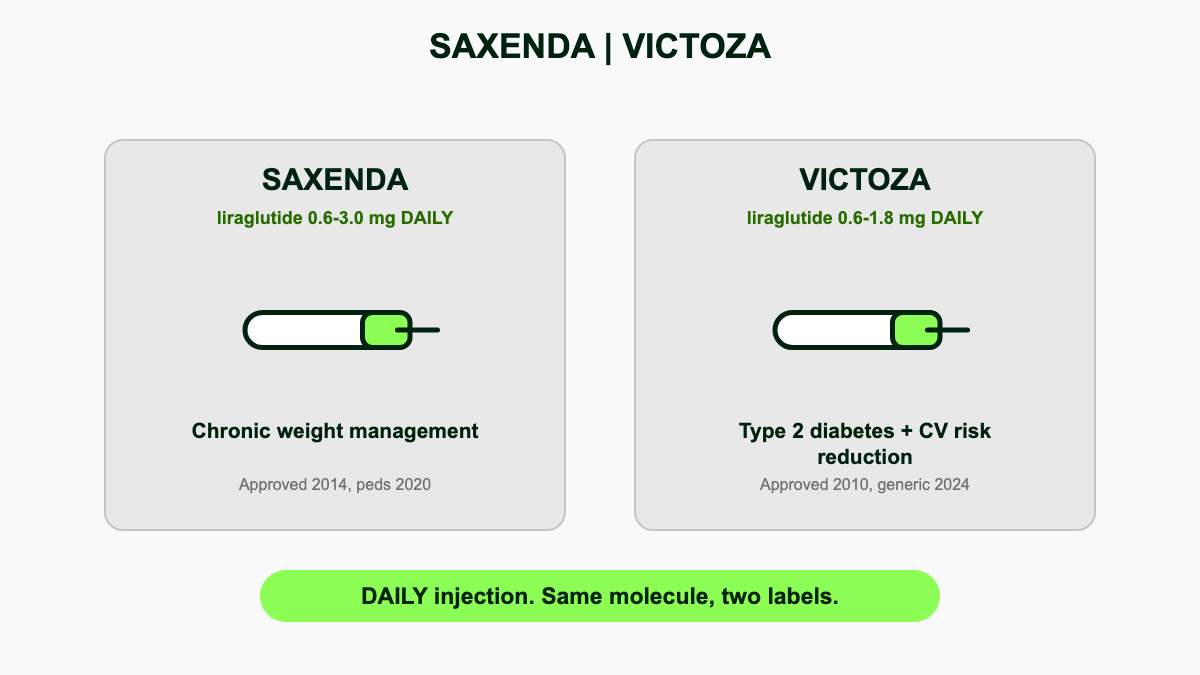
Saxenda packaged the same molecule into a higher-dose pen and won approval in December 2014 for chronic weight management in adults with a body mass index of 30 or more, or 27 or more with at least one weight-related comorbidity such as hypertension, dyslipidemia, or obstructive sleep apnea. In December 2020 the FDA extended that approval to adolescents 12 to 17 with a BMI in the obese range and a body weight above 60 kilograms, making Saxenda one of the first prescription anti-obesity drugs cleared for teens. Xultophy, the fixed-ratio combination with insulin degludec, is sold for type 2 diabetes patients who need basal insulin plus a GLP-1 agonist in one daily injection. [2][3]
Dosing and titration
Both products use a multidose prefilled pen and are injected subcutaneously into the abdomen, thigh, or upper arm at any time of day, with or without food. Pens come pre-loaded; patients attach a fresh needle for each injection and dial the dose.
- Victoza (type 2 diabetes): start at 0.6 mg daily for one week to limit GI side effects, then increase to 1.2 mg. The dose can be raised to 1.8 mg if additional glycemic control is needed. The 0.6 mg starting dose is a tolerability step and is not effective for glucose lowering on its own. The same titration applies in pediatric patients aged 10 and older. [3][5]
- Saxenda (weight management): start at 0.6 mg daily and increase by 0.6 mg each week over five weeks, moving through 1.2, 1.8, 2.4, and finally 3.0 mg as the maintenance dose. If patients cannot tolerate a step-up, the titration can be paused for an extra week. Treatment is reassessed at 16 weeks; if a patient has not lost at least 4% of baseline body weight, guidelines suggest discontinuing. [4][6]
- Pediatric Saxenda (ages 12 to 17): the same 0.6 mg weekly step-up is used, with a target of 3.0 mg or the maximum tolerated dose up to 3.0 mg. If a teen has not lost at least 1% of baseline BMI after 12 weeks at the 3.0 mg dose, treatment should be reconsidered. [2]
If a dose is missed and the next scheduled dose is more than 12 hours away, patients take it as soon as remembered and resume the normal schedule the next day. If three or more consecutive days are skipped, both products require restarting at 0.6 mg and re-titrating, because tolerance to GI effects fades quickly. Unopened pens stay in the refrigerator at 36 to 46 degrees Fahrenheit. After first use, a pen can be kept refrigerated or at room temperature up to 86 degrees and must be discarded after 30 days. [11][12]
Drug interactions and special populations
Liraglutide slows gastric emptying, so the absorption of orally co-administered drugs can be delayed. Pharmacokinetic studies on acetaminophen, atorvastatin, griseofulvin, lisinopril, digoxin, and oral contraceptives showed modest reductions in maximum concentration and small delays in time to peak, but the total exposure was clinically unchanged. The label flags warfarin and other narrow-therapeutic-index oral medications as deserving extra monitoring rather than dose changes. [3][13]
Combination with sulfonylureas or insulin sharply raises hypoglycemia risk; the Victoza label recommends lowering the secretagogue dose when liraglutide is added. No dose adjustment is required for renal or hepatic impairment based on pharmacokinetic data, although clinical experience in severe disease is limited and Saxenda is not recommended in end-stage renal disease. Liraglutide crosses the placenta in animals at clinically relevant exposures and is not recommended in pregnancy; both Victoza and Saxenda labels advise stopping at least two months before a planned pregnancy because of the long titration. There are no data on transfer into human breast milk. Geriatric use does not require dose adjustment, although elderly patients may be more susceptible to dehydration from GI side effects. [2][3]
Weight loss results from the SCALE program
The SCALE clinical program supported the Saxenda approval and remains the canonical evidence base. It enrolled more than 5,000 adults across five core trials, each tailored to a different population.
- SCALE Obesity and Prediabetes randomized 3,731 adults without diabetes to liraglutide 3.0 mg or placebo for 56 weeks alongside diet and exercise counseling. Mean weight loss was 8.0% with liraglutide versus 2.6% on placebo. About 63.2% of liraglutide-treated patients lost at least 5% of body weight and 33.1% lost at least 10%, compared with 27.1% and 10.6% on placebo. Among the prediabetic subset, prediabetes regression to normoglycemia was substantially more common with liraglutide. [4][6]
- SCALE Diabetes studied 846 adults with type 2 diabetes and BMI of 27 or higher. Mean weight loss was about 6.0% with liraglutide 3.0 mg versus 2.0% with placebo over 56 weeks, smaller than in non-diabetic patients but accompanied by a 1.3% absolute HbA1c reduction. [4]
- SCALE Maintenance tested whether liraglutide could prevent weight regain after an initial 5% loss on a low-calorie diet. Liraglutide added a 5.9 kg placebo-corrected loss over 56 weeks, and 50.5% of liraglutide patients lost an additional 5% versus 21.8% on placebo. [4]
- SCALE Sleep Apnea enrolled 359 adults with moderate to severe obstructive sleep apnea who declined or could not tolerate CPAP. Body weight fell 5.7% on liraglutide versus 1.6% on placebo, and the apnea-hypopnea index dropped by an additional 6.1 events per hour with active drug. [4]
- SCALE Teens randomized 251 adolescents 12 to 17 with obesity to liraglutide or placebo for 56 weeks. The BMI standard deviation score fell more on liraglutide and 43.3% of teens reached at least a 5% reduction in BMI versus 18.7% on placebo. Those data supported the December 2020 pediatric Saxenda approval. [2]
Discontinuation matters. In open-label extensions, patients who stopped liraglutide regained much of the lost weight within a year, which mirrors the pattern later confirmed for semaglutide in STEP 4 and tirzepatide in SURMOUNT-4. The clinical implication is that liraglutide for obesity should be framed as a chronic therapy rather than a short induction. [4]
Cardiovascular benefit: the LEADER trial
LEADER randomized 9,340 adults with type 2 diabetes and high cardiovascular risk to liraglutide 1.8 mg or placebo and followed them for a median of 3.8 years. About 81% of participants had established cardiovascular disease at baseline. The primary three-point MACE composite (cardiovascular death, nonfatal MI, or nonfatal stroke) occurred in 13.0% of the liraglutide group versus 14.9% on placebo, a hazard ratio of 0.87 (95% CI 0.78 to 0.97, p=0.01 for superiority). Cardiovascular death fell with a hazard ratio of 0.78 (95% CI 0.66 to 0.93) and all-cause mortality with a hazard ratio of 0.85 (95% CI 0.74 to 0.97). Nonfatal myocardial infarction and nonfatal stroke trended in the same direction without reaching statistical significance individually. [7]
The trial also recorded a renal benefit. A composite of new or worsening nephropathy occurred in 5.7% of liraglutide patients versus 7.2% on placebo, hazard ratio 0.78, driven mostly by a reduction in new-onset persistent macroalbuminuria. Pancreatitis rates were numerically lower with liraglutide and gallbladder events were modestly higher, but neither difference reached significance. The cardiovascular benefit emerged gradually over months, consistent with an effect on atherosclerotic disease progression rather than acute hemodynamics. [7]
Those results moved liraglutide into a preferred slot in ADA and EASD treatment algorithms for type 2 diabetes patients with established atherosclerotic cardiovascular disease, alongside semaglutide and dulaglutide. The FDA added the cardiovascular indication to the Victoza label in August 2017. The European Medicines Agency followed shortly after. As of 2026, LEADER remains the only outcomes file in the GLP-1 class that combines a cardiovascular death reduction with an all-cause mortality reduction in adults with diabetes. [3][7]
Side effects and safety warnings
Gastrointestinal effects dominate the side-effect profile. In Saxenda trials, nausea affected about 39% of patients, diarrhea or constipation around 20%, and vomiting near 15%. Symptoms cluster during titration and usually fade over a few weeks. Roughly 10% of patients discontinue Saxenda due to adverse effects, a discontinuation rate that runs higher than weekly semaglutide in head-to-head data. Other common reactions include headache, fatigue, dyspepsia, dizziness, and injection site reactions. [6][9]
Other safety concerns include:
- Boxed warning for thyroid C-cell tumors. Liraglutide caused medullary thyroid carcinoma in rodents at clinically relevant exposures. Human relevance is unclear, but the drug is contraindicated in anyone with a personal or family history of medullary thyroid carcinoma or Multiple Endocrine Neoplasia syndrome type 2 (MEN 2). Patients should be counseled about symptoms of thyroid tumors (neck mass, dysphagia, hoarseness, dyspnea). Routine calcitonin or thyroid ultrasound monitoring is not currently recommended. [3][8]
- Acute pancreatitis. Cases have been reported in postmarketing surveillance. Patients with persistent severe abdominal pain should stop the drug and be evaluated. Liraglutide should not be restarted if pancreatitis is confirmed. [3][8]
- Gallbladder disease. Cholelithiasis and cholecystitis are more common, partly because rapid weight loss itself is a risk factor. The signal appears slightly stronger with liraglutide than with semaglutide in pooled obesity trials, although neither head-to-head difference is large. The Saxenda label notes a 2.2% incidence of cholelithiasis versus 0.8% on placebo. [3][6]
- Acute kidney injury, usually in the setting of dehydration from vomiting or diarrhea. Patients with chronic kidney disease, the elderly, and those on diuretics or ACE inhibitors are at higher risk and should maintain hydration during titration. [3]
- Hypoglycemia when combined with sulfonylureas or insulin, which often need dose reduction. Liraglutide monotherapy carries minimal hypoglycemia risk because of the glucose-dependent mechanism. [5]
- Heart rate increase. Resting heart rate rises by an average of 2 to 3 beats per minute on liraglutide, with a small subset gaining more than 20 bpm. The clinical significance is unclear, but persistent tachycardia warrants drug discontinuation. [2][3]
- Hypersensitivity reactions. Anaphylaxis and angioedema have been reported. Liraglutide is contraindicated in patients with prior serious hypersensitivity to the drug. [2]
The FDA boxed warning for suicidal ideation that previously appeared on Saxenda was removed in early 2026 after a class-wide safety review found no consistent signal in postmarketing data. Patients with active major depression should still be monitored, and the label retains routine guidance about mood changes. [1][8]
Liraglutide vs semaglutide and tirzepatide
The head-to-head SUSTAIN 10 trial compared semaglutide 1.0 mg weekly with liraglutide 1.2 mg daily in type 2 diabetes. Semaglutide produced a 0.69% greater HbA1c reduction and 3.83 kg more weight loss at 30 weeks. The STEP 8 trial pitted semaglutide 2.4 mg weekly against liraglutide 3.0 mg daily for obesity in 338 adults without diabetes and reported 15.8% mean weight loss with semaglutide versus 6.4% with liraglutide over 68 weeks (difference 9.4 percentage points, p<0.001). The proportions reaching at least 10%, 15%, and 20% body weight loss were 70.9%, 55.6%, and 38.5% on semaglutide versus 25.6%, 12.0%, and 6.0% on liraglutide. Treatment discontinuation was higher with liraglutide at 27.6% versus 13.5%, and adverse-event-driven discontinuation was 12.6% versus 3.2%. [9]
Tirzepatide, a dual GIP/GLP-1 agonist, has produced even larger weight loss in the SURMOUNT trials, in the 20% range at the 15 mg dose. Liraglutide is now the least potent of the major incretin therapies on the market, though it remains the only one with a daily formulation, which some patients prefer for predictable side-effect timing or easier dose adjustment. The shorter half-life is also useful when surgery, pregnancy planning, or pronounced GI intolerance requires fast washout. Liraglutide clears the system in about three days versus three to four weeks for the weekly drugs. [9]
For type 2 diabetes specifically, the daily-dose CV file (LEADER, 1.8 mg) and the weekly-dose CV file (SUSTAIN-6 and SELECT, semaglutide) are roughly comparable in MACE reduction, but only LEADER and SELECT showed an all-cause mortality signal. That keeps liraglutide on most expert algorithms even where semaglutide is the default starter. [3][7]
The first generic GLP-1 and what it changes
The U.S. patent landscape for liraglutide finally cracked in 2024. Teva launched a generic Victoza in late June 2024 under a settlement that gave it 180-day pediatric exclusivity tied to its sponsorship of adolescent trials. The FDA approved the first true AB-rated generic from Hikma Pharmaceuticals on December 23, 2024 and Hikma launched it three days later, ending more than 14 years of branded exclusivity for the molecule. According to IQVIA data Hikma cited at launch, U.S. sales of branded Victoza had reached approximately $1.3 billion in the 12 months ending October 2024. [10][14]
The Hikma launch matters as a class precedent. It is the first generic GLP-1 receptor agonist on the U.S. market, and it shows that compounded shortages aside, generic injectable GLP-1 production is feasible. Cash prices on the Hikma generic settled in the $400 to $600 range per month within the first quarter of availability, roughly half the branded list price. Saxenda exclusivity expired in 2024 as well, but a generic 3.0 mg obesity-dose product had not yet launched at the time of the first Hikma generic, with several abbreviated new drug applications pending FDA review. [10][14]
Cost and access in the United States
Branded Saxenda still carries a list price near $1,349 for a 30-day supply of five 3.0 mg pens, and branded Victoza sits in the $800 to $1,000 range. Insurance coverage for Saxenda has tightened as payers steer obesity patients toward weekly Wegovy or Zepbound, and prior authorization is the norm. Novo Nordisk runs the NovoCare savings card program for commercially insured patients, which can drop branded Saxenda copays to around $25 a month for eligible users; income-based patient assistance is available through the Novo Nordisk Patient Assistance Program for uninsured patients meeting financial criteria. [10]
The economics shift sharply once a generic is on the script. Generic liraglutide for diabetes is now eligible for standard formulary tiers and is available without prior authorization through many plans. For patients who genuinely need a GLP-1 but cannot get coverage for Wegovy, Zepbound, or branded Saxenda, off-label use of generic Victoza for weight management is a conversation that prescribers and payers are increasingly having, even though only the 3.0 mg Saxenda strength is FDA-approved for obesity. [10][14]
Pediatric use: ELLIPSE and SCALE Teens
Liraglutide is one of the few non-insulin diabetes drugs with rigorous pediatric data. The ELLIPSE trial randomized 134 patients aged 10 to 17 with type 2 diabetes inadequately controlled on metformin (with or without basal insulin) to liraglutide or placebo for 26 weeks, followed by a 26-week open-label extension. HbA1c fell by 0.64 percentage points on liraglutide and rose by 0.42 on placebo, an estimated treatment difference of 1.06 percentage points (p<0.001). The safety profile mirrored the adult experience, with more nausea on liraglutide but no new pediatric-specific signals. Those data drove the June 2019 Victoza pediatric approval. [3]
SCALE Teens followed for the obesity indication. The 56-week trial enrolled 251 adolescents aged 12 to 17 with obesity (BMI at or above the 95th percentile for age and sex) and a body weight above 60 kilograms. The primary endpoint was change in BMI standard deviation score, which fell more on liraglutide than placebo, with the active drug producing a placebo-corrected reduction in BMI z-score of 0.22. About 43.3% of teens on liraglutide achieved at least a 5% reduction in BMI versus 18.7% on placebo. Weight regain after stopping the drug was rapid in the off-treatment follow-up phase, again underscoring chronic-disease framing. [2]
Glycemic and metabolic effects beyond weight
Across the LEAD program (the Phase 3 diabetes trials that supported the original Victoza approval), liraglutide 1.8 mg lowered HbA1c by 1.0 to 1.5 percentage points depending on background therapy, with consistent fasting plasma glucose reductions of 25 to 40 mg/dL. The drug performed at least as well as glimepiride and exenatide BID head-to-head, and it added meaningful glycemic effect on top of metformin, sulfonylureas, and basal insulin without requiring titration of those agents in most patients. [3][5]
Beyond glucose, liraglutide reliably lowers systolic blood pressure by 2 to 6 mm Hg within the first weeks of dosing, an effect that precedes meaningful weight loss and likely reflects natriuresis combined with vascular effects of GLP-1 receptor activation. Modest reductions in triglycerides and low-density lipoprotein cholesterol have also been observed, and high-sensitivity C-reactive protein falls. None of these biomarker shifts is large in isolation, but together they help explain the LEADER cardiovascular signal. [4][7]
The drug also has data in nonalcoholic steatohepatitis. The LEAN trial randomized 52 patients with biopsy-proven NASH to liraglutide 1.8 mg or placebo for 48 weeks. Histological resolution of NASH without worsening fibrosis occurred in 39% of liraglutide patients versus 9% on placebo. That signal seeded a wider GLP-1 NASH literature that semaglutide later expanded. [4]
Practical injection technique and patient experience
Both Victoza and Saxenda pens are reusable multidose devices that hold 18 mg in 3 mL of solution. Patients screw on a fresh disposable needle (most often a 32-gauge pen needle), prime the pen if it is the first use, dial the dose, and inject subcutaneously. The injection site rotates between the abdomen, thigh, and upper arm. Injections take less than 10 seconds once the needle is in place, and the dose-counter clicks audibly during titration which helps patients with low vision. [11][12]
Storage is straightforward but particular. Unopened pens stay refrigerated until first use, then can be kept at room temperature up to 86 degrees Fahrenheit or refrigerated for 30 days. Patients should not freeze pens, expose them to direct sunlight, or store them with the needle attached because the latter can let air or contaminants enter the cartridge. Travelers should pack pens in carry-on luggage with prescription documentation. The most common patient frustration in the first month is the daily injection schedule itself, which contrasts with the once-weekly pens many newer GLP-1 patients now expect, and a small subset of patients describe the daily reminder as a reason they switch to semaglutide once tolerance is established. [11][12]
Where liraglutide fits in 2026
Four things keep liraglutide relevant. First, the LEADER cardiovascular evidence is settled and applies regardless of weight loss magnitude, with a unique combined CV-death and all-cause mortality benefit. Second, the daily injection schedule lets patients pause or restart more flexibly than a weekly drug, which can matter for tolerability, perioperative planning, or pregnancy timing. Third, the pediatric data for both Victoza and Saxenda give clinicians a GLP-1 option for younger patients before semaglutide for obesity gained its own pediatric label. Fourth, generics have arrived.
Hikma launched the first generic Victoza in the United States on December 26, 2024 under FDA approval issued December 23, and Teva had a generic on the market earlier that year under a pediatric exclusivity settlement. List prices for branded Saxenda still sit near $1,300 a month, but generic Victoza is materially cheaper and Saxenda exclusivity has expired, with multiple generic obesity-dose filings pending. For payers and patients facing prior-authorization hurdles on Wegovy or Zepbound, a generic GLP-1 with a real cardiovascular outcomes file is hard to dismiss. Liraglutide is no longer the most powerful agent in the class, but it has become the most affordable injectable GLP-1 with outcomes data, and for many patients in 2026 that combination is what actually matters. [1][10][14]
References
- Liraglutide. Wikipedia. Accessed May 2026. https://en.wikipedia.org/wiki/Liraglutide
- U.S. Food and Drug Administration. Saxenda (liraglutide) approval, December 2014. FDA news release
- U.S. Food and Drug Administration. Questions and Answers: Safety Requirements for Victoza (liraglutide). fda.gov
- Mehta A, Marso SP, Neeland IJ. Liraglutide for weight management: a critical review of the evidence. Obes Sci Pract. 2017;3(1):3-14. PMC5358074
- MedlinePlus. Liraglutide Injection. U.S. National Library of Medicine. medlineplus.gov
- Mancini MC, de Melo ME. Liraglutide (Saxenda) for Weight Loss. Am Fam Physician. 2016;94(2):161-162. aafp.org
- Marso SP, Daniels GH, Brown-Frandsen K, et al. Liraglutide and Cardiovascular Outcomes in Type 2 Diabetes (LEADER). N Engl J Med. 2016;375(4):311-322. PubMed 27295427
- Mayo Clinic. Liraglutide (subcutaneous route): description and brand names. mayoclinic.org
- Rubino DM, Greenway FL, Khalid U, et al. Effect of Weekly Subcutaneous Semaglutide vs Daily Liraglutide on Body Weight (STEP 8). JAMA. 2022;327(2):138-150. JAMA
- Hikma Pharmaceuticals. Hikma receives FDA approval and launches the generic version of Victoza (liraglutide) in the US. Press release, 26 December 2024. hikma.com
- Cleveland Clinic. Liraglutide injection for weight management. my.clevelandclinic.org
- U.S. National Library of Medicine. Liraglutide injection: storage and missed dose guidance. MedlinePlus. medlineplus.gov
- Marso SP, et al. LEADER trial cardiovascular outcomes summary. NEJM 2016. nejm.org
- U.S. Food and Drug Administration. FDA approves first generic of once-daily GLP-1 injection to lower blood sugar in patients with type 2 diabetes. Press announcement, 23 December 2024. fda.gov