Peptide Calculator: Converting a Dose Into Syringe Units Without a Unit Error
Summary: A peptide calculator performs four divisions: concentration, volume per dose, syringe units, and doses per vial. This page shows the arithmetic behind each one, tabulates verified worked examples, and sets out the unit-conversion errors that actually produce wrong draws, chiefly the belief that a syringe unit is a mass rather than a volume.
This content is for informational purposes only and is not medical advice. Always consult a qualified healthcare provider before starting, changing, or stopping any medication.
A peptide calculator converts a vial's stated milligram content, the volume of bacteriostatic water you add, and the dose your protocol specifies into three numbers: concentration in mg/mL, injection volume in mL, and the mark to draw to on a U-100 syringe. It also returns doses per vial. Every figure it produces comes from four divisions you can repeat by hand.
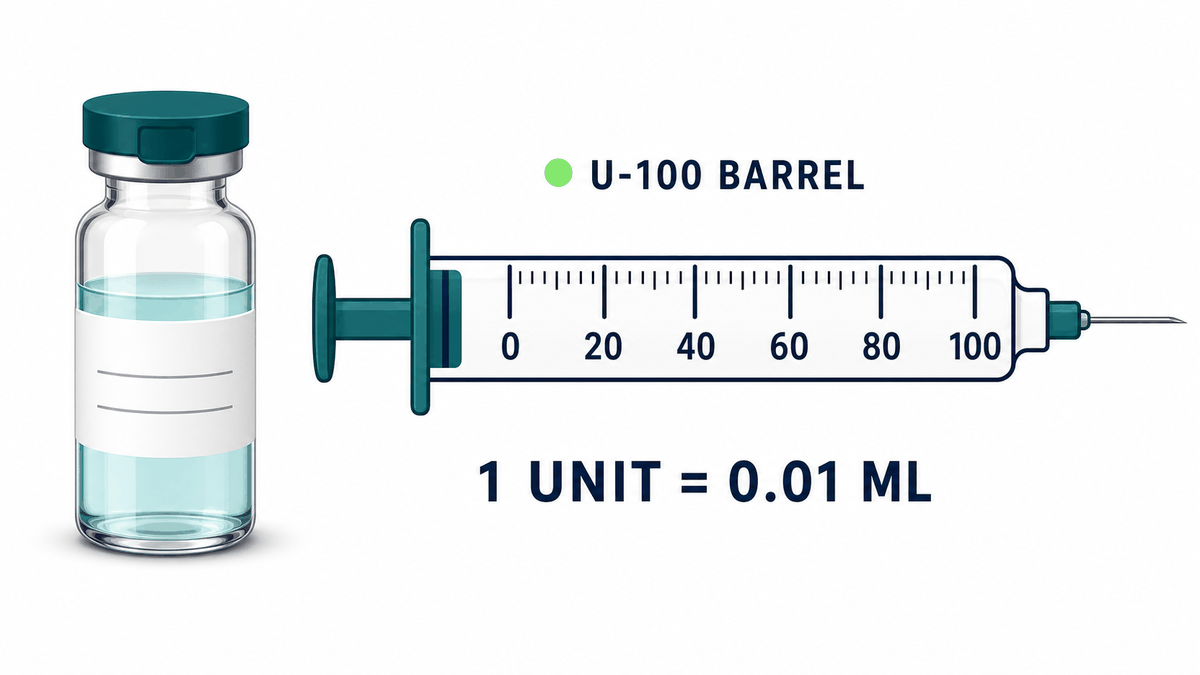
The four formulas a peptide calculator runs
Every reconstitution calculator, whatever its interface, is running these. Nothing else is happening.
concentration (mg/mL) = vial strength (mg) / BAC water volume (mL)
injection volume (mL) = dose (mg) / concentration (mg/mL)
U-100 syringe units   = injection volume (mL) x 100
doses per vial        = vial strength (mg) / dose (mg)

1 mg = 1000 mcg
Two of those lines carry almost all the risk. The syringe-units line is a unit conversion that people read as a dosage. The mcg-to-mg line is a factor of 1000 that people drop.
A worked instance of all four, so the rest of this page has a reference point. A 5 mg vial reconstituted with 2 mL of bacteriostatic water gives 5 / 2 = 2.5 mg/mL. A 250 mcg dose is 0.25 mg, so the injection volume is 0.25 / 2.5 = 0.1 mL, which is 0.1 x 100 = 10 units on a U-100 syringe. Doses per vial are 5 / 0.25 = 20.
If you want the arithmetic run for you before you check it by hand, PeptideDeck publishes a peptide calculator that takes syringe barrel, vial size, BAC water volume and target dose and returns the concentration, the volume per dose, the doses per vial, and the unit mark on a U-100 scale [9]. It carries presets for BPC-157, TB-500, CJC-1295 (No DAC), ipamorelin, retatrutide, GHK-Cu, MOTS-c and semax, plus a half-life dose mode and a microdosing schedule generator. Use it the way you would use any calculator on a number that matters: get the answer, then reproduce it once by hand before the needle goes anywhere near the vial.
What does "units" mean on a U-100 insulin syringe?
This is the single most consequential misunderstanding in peptide dosing, and it is worth stating in isolation because it survives being read out of context.
A unit on a U-100 insulin syringe is a volume, not a mass. U-100 describes a syringe graduated for insulin at a concentration of 100 units per milliliter. One unit therefore occupies 1/100 of a milliliter. That is 0.01 mL, or 10 microliters, on every U-100 barrel ever made [5].
A unit is not a milligram. It is not a microgram. It is not an International Unit of biological activity, which is a completely separate concept defined per substance by potency assay. When a peptide calculator tells you to draw to 10 units, it is telling you to fill 0.1 mL of barrel. How much peptide sits in that 0.1 mL depends entirely on the concentration you created when you chose your water volume, and the syringe has no way of knowing what that is.
Some calculators and syringe makers label the scale "IU" rather than "units". Read that label as volume regardless. The ISMP maintains "U" on its list of error-prone abbreviations precisely because it is misread, and recommends writing the word out [2].
The consequence that follows from this: the same unit number can deliver different amounts of peptide. Ten units is always 0.1 mL, but 0.1 mL of a 2.5 mg/mL solution is 0.25 mg and 0.1 mL of a 10 mg/mL solution is 1 mg. A four-fold difference from the same syringe reading.
Barrel sizes and what changes between them
| Barrel | Capacity | Units at U-100 | Volume of one unit | Typical graduation |
|---|---|---|---|---|
| 1 mL | 1 mL | 100 units | 0.01 mL | 1 or 2 unit marks |
| Half mL | 0.5 mL | 50 units | 0.01 mL | 1 unit marks |
| Third mL | 0.3 mL | 30 units | 0.01 mL | Half unit marks |
The column that does not change is the one that matters. A unit is 0.01 mL on all three. What changes is total capacity and how finely the barrel is subdivided, which decides how precisely you can hit a computed volume. Graduation intervals vary between manufacturers, so read the barrel in front of you rather than assuming.
How do you calculate peptide dosage step by step?
Four steps, in this order. The example below uses a 5 mg vial, 2 mL of bacteriostatic water, and a 250 mcg dose.
- Convert the dose to milligrams. 250 mcg / 1000 = 0.25 mg. Do this first, always, because the vial is labeled in mg and the protocol is often written in mcg [1].
- Compute the concentration. 5 mg / 2 mL = 2.5 mg/mL. This is fixed the moment you add the water and cannot be changed afterwards.
- Compute the injection volume. 0.25 mg / 2.5 mg/mL = 0.1 mL.
- Convert volume to syringe units. 0.1 mL x 100 = 10 units on a U-100 barrel.
Then reverse it as a check. Ten units is 0.10 mL. 0.10 mL x 2.5 mg/mL = 0.25 mg, which is 250 mcg. The round trip closes, so the draw is right.
Doses per vial, separately: 5 mg / 0.25 mg = 20 doses.
Worked reconstitution examples, every row recomputed
Each row is an independent calculation from the same four formulas. Concentration is vial divided by water. Volume is dose divided by concentration. Units are volume times 100. Doses per vial are vial divided by dose.
| Vial | BAC water | Concentration | Dose | Dose in mg | Volume | U-100 units | Doses per vial |
|---|---|---|---|---|---|---|---|
| 5 mg | 2 mL | 2.5 mg/mL | 250 mcg | 0.25 mg | 0.1 mL | 10 units | 20 |
| 5 mg | 1 mL | 5 mg/mL | 250 mcg | 0.25 mg | 0.05 mL | 5 units | 20 |
| 5 mg | 2.5 mL | 2 mg/mL | 100 mcg | 0.1 mg | 0.05 mL | 5 units | 50 |
| 10 mg | 2 mL | 5 mg/mL | 500 mcg | 0.5 mg | 0.1 mL | 10 units | 20 |
| 10 mg | 5 mL | 2 mg/mL | 500 mcg | 0.5 mg | 0.25 mL | 25 units | 20 |
| 10 mg | 1 mL | 10 mg/mL | 250 mcg | 0.25 mg | 0.025 mL | 2.5 units | 40 |
| 15 mg | 3 mL | 5 mg/mL | 1000 mcg | 1 mg | 0.2 mL | 20 units | 15 |
| 20 mg | 2 mL | 10 mg/mL | 2000 mcg | 2 mg | 0.2 mL | 20 units | 10 |
| 30 mg | 3 mL | 10 mg/mL | 2500 mcg | 2.5 mg | 0.25 mL | 25 units | 12 |
| 50 mg | 5 mL | 10 mg/mL | 5000 mcg | 5 mg | 0.5 mL | 50 units | 10 |
Row six is deliberately included as a failure case. A 10 mg vial in 1 mL of water gives 10 mg/mL, and a 250 mcg dose from that solution is 0.025 mL, which is 2.5 units. No 1 mL barrel is graduated finely enough to draw 2.5 units reliably. The arithmetic is correct and the draw is still not executable. That is a signal to change the water volume, not to guess at the plunger.
How many units is 250 mcg? It depends on the dilution
There is no fixed answer, and any source that gives you one without asking about your vial is wrong. Units are volume, so the answer moves with concentration. The table below holds the dose constant at 500 mcg and varies only the water added to a single 10 mg vial.
| Vial | BAC water | Concentration | Dose | Volume | U-100 units | Doses per vial |
|---|---|---|---|---|---|---|
| 10 mg | 1 mL | 10 mg/mL | 500 mcg | 0.05 mL | 5 units | 20 |
| 10 mg | 2 mL | 5 mg/mL | 500 mcg | 0.1 mL | 10 units | 20 |
| 10 mg | 4 mL | 2.5 mg/mL | 500 mcg | 0.2 mL | 20 units | 20 |
| 10 mg | 5 mL | 2 mg/mL | 500 mcg | 0.25 mL | 25 units | 20 |
Two things fall out of that table.
The unit reading spans 5 to 25, a five-fold range, for the identical dose. Anyone who memorizes "my dose is 10 units" and then reconstitutes the next vial differently will be off by whatever ratio they changed the water by.
Doses per vial is 20 in every row. Diluting further does not create more peptide. It spreads the same 10 mg over more liquid, which makes each draw larger and easier to measure accurately, and costs nothing in total doses. That is the entire argument for using more water rather than less.
Milligrams and micrograms: the conversion that produces the worst errors
One milligram is 1000 micrograms [1]. The abbreviation for microgram in clinical writing is mcg, not the micro symbol, because the symbol is misread as an m [2].
| Micrograms | Milligrams |
|---|---|
| 50 mcg | 0.05 mg |
| 100 mcg | 0.1 mg |
| 250 mcg | 0.25 mg |
| 500 mcg | 0.5 mg |
| 750 mcg | 0.75 mg |
| 1000 mcg | 1 mg |
| 2500 mcg | 2.5 mg |
| 5000 mcg | 5 mg |
The reason this specific conversion is dangerous is that the error is not a near miss. Entering 250 into a calculator's mg field when the protocol said 250 mcg is a factor of 1000. At 2.5 mg/mL that turns a 0.1 mL draw into a 100 mL draw.
That particular slip is self-detecting: 100 mL is a hundred times the capacity of a 1 mL barrel, so the calculator returns a volume no syringe can hold and the mistake is obvious. The dangerous version is the one that stays inside the barrel, which is why the reverse check in the next section is worth the fifteen seconds it takes.
Five unit-conversion errors that actually happen
- Reading a syringe unit as a milligram. "I take 20 units" is not a dose. It is a volume, and it means nothing without the concentration attached. Record doses in mg or mcg and derive the units each time.
- Carrying last vial's unit number forward. The unit mark is only valid for the concentration it was computed from. A new vial reconstituted with a different water volume invalidates it entirely.
- Mixing mg and mcg in the same calculation. Convert everything to milligrams before dividing. Every formula on this page assumes milligrams throughout.
- Assuming U-100 on a U-40 barrel. One unit is 0.01 mL at U-100 and 0.025 mL at U-40. The syringes look similar and the scales are not interchangeable.
- Reading a third mL barrel as though it were a 1 mL barrel. A 0.3 mL barrel tops out at 30 units. If a calculator returns 45 units, that barrel physically cannot deliver the dose in one draw, and the number of marks between two printed labels is different from the 1 mL barrel you may be used to.
How to self-check a dose in thirty seconds before you draw
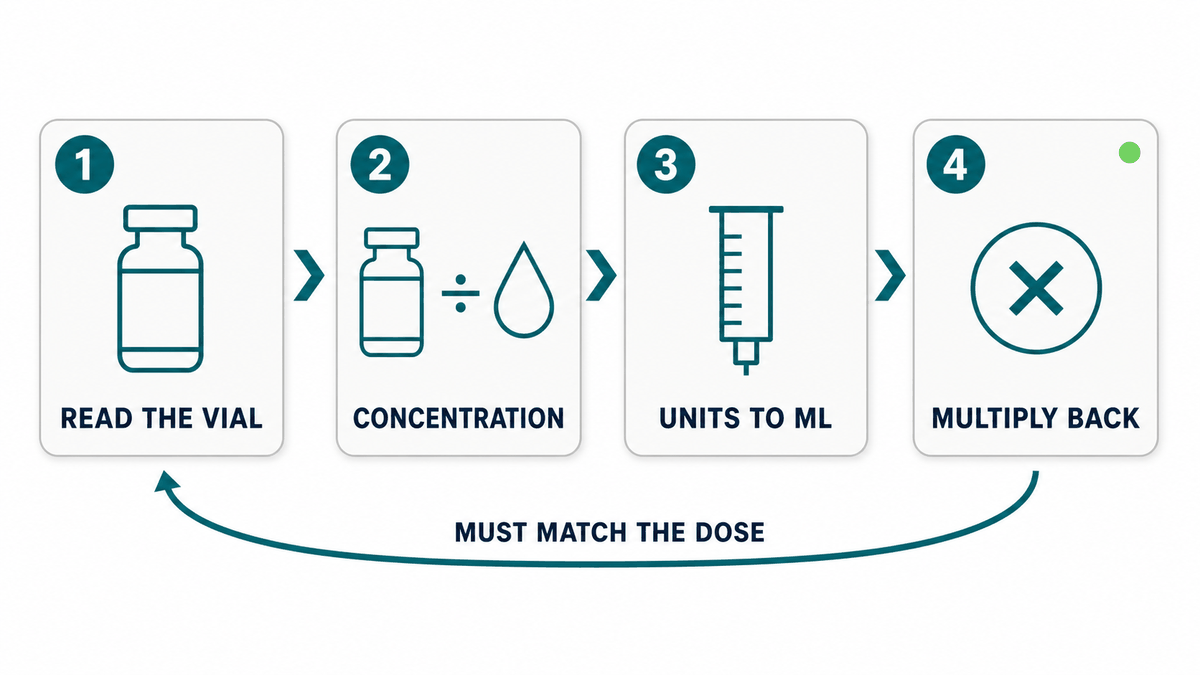
The check is a reversal. You computed forward from dose to units. Now compute backward from units to dose and confirm you land where you started.
- Read the vial label out loud. Vial strength in mg and, if the vial is already reconstituted, the concentration and reconstitution date you wrote on it.
- Restate the concentration. Vial mg divided by the water volume you actually added. Not the volume you intended to add.
- Multiply the unit mark by 0.01 to get milliliters. 20 units is 0.20 mL. This step is where a U-40 barrel or a misread scale gets caught.
- Multiply that volume by the concentration. The product must equal your intended dose in mg. If it does not, stop and recompute rather than adjusting the plunger to taste.
Worked once, forward and back, on the reference example: dose 250 mcg becomes 0.25 mg, divided by 2.5 mg/mL gives 0.1 mL, times 100 gives 10 units. Reversing, 10 units times 0.01 mL gives 0.1 mL, times 2.5 mg/mL gives 0.25 mg. Closed.
How much BAC water should I use?
Most guidance treats water volume as a given and solves for units. It is more useful to invert it, because water volume is the one variable you actually control at reconstitution time. Rearranging the first three formulas:
BAC water (mL) = target units x vial strength (mg) / (100 x dose (mg))
Choose a unit mark you can read comfortably, then let the formula tell you how much water produces it. A draw somewhere between 10 and 50 units is generally easy to read on a 1 mL barrel and leaves room for the dose to be increased later without exceeding the barrel.
| Vial | Dose | Target units | BAC water to add | Resulting concentration | Volume | Actual units | Doses per vial |
|---|---|---|---|---|---|---|---|
| 5 mg | 250 mcg | 20 units | 4 mL | 1.25 mg/mL | 0.2 mL | 20 units | 20 |
| 5 mg | 100 mcg | 10 units | 5 mL | 1 mg/mL | 0.1 mL | 10 units | 50 |
| 10 mg | 500 mcg | 20 units | 4 mL | 2.5 mg/mL | 0.2 mL | 20 units | 20 |
| 10 mg | 250 mcg | 10 units | 4 mL | 2.5 mg/mL | 0.1 mL | 10 units | 40 |
| 20 mg | 2000 mcg | 20 units | 2 mL | 10 mg/mL | 0.2 mL | 20 units | 10 |
| 30 mg | 2500 mcg | 20 units | 2.4 mL | 12.5 mg/mL | 0.2 mL | 20 units | 12 |
Two physical constraints bound the answer, and the formula knows about neither.
The vial has to hold the water. A small peptide vial is commonly a 2 mL or 3 mL glass vial, and the formula will happily hand you 8 mL if you ask for a large unit count on a small dose. Check the vial's capacity before you commit to a number.
The solution has to last. Bacteriostatic water contains benzyl alcohol as a preservative, which suppresses bacterial growth in a multiple-dose container across repeated withdrawals; the Hospira label specifies 0.9% (9 mg/mL) or 1.1% (11 mg/mL) [3]. It does not extend the chemical stability of the peptide indefinitely. Diluting so far that a vial takes months to finish means the last doses sit in solution far longer than the first, which is the practical reason compounding pharmacies assign beyond-use dates to reconstituted multiple-dose vials under the USP framework [6] [7].
When the calculator returns a number the syringe cannot draw
Take a 10 mg vial in 3 mL of water. Concentration is 10 / 3 = 3.3333 mg/mL. A 750 mcg dose is 0.75 mg, so the volume is 0.75 / 3.3333 = 0.225 mL, which is 22.5 units. Doses per vial are 10 / 0.75 = 13.33, meaning 13 complete doses with 0.25 mg left over.
Half a unit is 0.005 mL. On a 1 mL barrel marked in 2-unit steps, 22.5 units falls between marks with no way to split the difference reliably. Your options and their arithmetic:
- Draw 22 units. 0.22 mL x 3.3333 mg/mL = 0.7333 mg, which is 2.22 percent below the 0.75 mg target.
- Draw 23 units. 0.23 mL x 3.3333 mg/mL = 0.7667 mg, which is 2.22 percent above target.
- Use a third mL barrel. Half-unit graduations make 22.5 units directly readable, and 22.5 units sits inside the 30-unit capacity.
- Change the water volume. 4 mL instead of 3 mL gives 2.5 mg/mL, and 0.75 / 2.5 = 0.3 mL = 30 units exactly.
A rounding error of about 2 percent is small. A rounding error of 20 percent is not, and that is what happens when the computed draw is tiny. Back at row six of the worked table, a 2.5 unit target on a barrel marked in 2-unit steps forces a choice between 2 units and 4 units. At 10 mg/mL those deliver 0.2 mg and 0.4 mg against a 0.25 mg target, which is 20 percent low or 60 percent high. The fix is not a steadier hand. The fix is more water.
What the half-life mode is calculating
A half-life dose calculator answers a different question from the reconstitution math above. Reconstitution tells you what is in the syringe. A half-life model estimates how much of previous doses is still circulating when the next one lands.
The arithmetic is a geometric series. If the dosing interval equals the elimination half-life, each dose has decayed to exactly half when its successor arrives, so the amount present just after the nth dose is the sum of a series that converges on twice a single dose.
Semaglutide is the convenient worked case because its label states both figures: an elimination half-life of approximately 1 week, with weekly dosing, and steady-state exposure achieved after 4 to 5 weeks of once-weekly administration [4].
| Dose number | Amount present just after the dose | Percent of steady state |
|---|---|---|
| 1 | 1 x D | 50 percent |
| 2 | 1.5 x D | 75 percent |
| 3 | 1.75 x D | 87.5 percent |
| 4 | 1.875 x D | 93.75 percent |
| 5 | 1.9375 x D | 96.875 percent |
| Steady state | 2 x D | 100 percent |
Each row is the previous row halved and added to one fresh dose: 1, then 1/2 + 1 = 1.5, then 0.75 + 1 = 1.75, and so on toward 2. The arithmetic reproduces the label's "4 to 5 weeks" statement without any pharmacology, because at dose 4 you are at 93.75 percent and at dose 5 you are at 96.875 percent [4].
Two honest limits on that model. It is a single-compartment first-order approximation that assumes complete absorption, a constant half-life and perfect adherence, none of which is exactly true. And it applies only to compounds whose half-life has been measured. For research peptides with no published human pharmacokinetics, there is no half-life to put into the formula, and a model built on an assumed number is a guess with decimal places.
What a peptide calculator cannot tell you
The arithmetic is exact. The inputs are not, and the calculator has no way to know it.
It cannot verify the vial contains what the label says. Every calculation on this page begins with the milligram figure printed on the vial. For an FDA-approved product dispensed by a pharmacy, that figure is backed by the regulatory framework the FDA describes for approved and compounded drugs [7]. For material sold as research-grade, the number is a vendor claim, and the FDA has warned specifically about unapproved GLP-1 products sold outside that framework [8]. If the true content is 20 percent below label, every output is 20 percent wrong and the arithmetic will still reconcile perfectly.
It cannot assess sterility. Bacteriostatic water suppresses bacterial growth in a multiple-dose vial [3]. It does not sterilize a contaminated vial, and it does not make a non-sterile powder safe.
It cannot choose a dose. Which dose belongs in the input field is a clinical question with a clinical answer. The calculator's job starts after that number exists.
It cannot account for residual volume. Small amounts remain in the needle hub and vial. Doses-per-vial figures are theoretical maxima, which is why the 13.33 in the example above should be planned as 13.
For medication-specific procedure rather than general arithmetic, this site covers how to reconstitute semaglutide step by step, the milliliter conversions for tirzepatide at every common concentration, and retatrutide reconstitution including its regulatory status. Approved-drug titration schedules are collected in the GLP-1 dosing chart.
Frequently asked questions
- What is a peptide calculator?
- A peptide calculator is a reconstitution and dosing tool that converts three inputs into four outputs. You enter the vial strength in milligrams, the volume of bacteriostatic water you plan to add, and your target dose. It returns the concentration in mg/mL, the injection volume in mL, the corresponding mark on a U-100 syringe, and the number of doses the vial contains. Every output is a single division you can verify by hand.
- How many units is 250 mcg on an insulin syringe?
- There is no single answer, because units measure volume rather than mass. At 2.5 mg/mL, 250 mcg is 0.25 mg divided by 2.5, which is 0.1 mL, which is 10 units. At 5 mg/mL the same dose is 0.05 mL, which is 5 units. At 10 mg/mL it is 0.025 mL, or 2.5 units, which is too small to draw reliably. You must know your concentration before the question has an answer.
- Is a syringe unit the same as a milligram?
- No. On a U-100 insulin syringe one unit is 1/100 of a milliliter, which is 0.01 mL or 10 microliters. It is a volume marking, and it is identical on 1 mL, half mL and third mL barrels. It is not a milligram, not a microgram, and not an International Unit of biological activity. The mass delivered by a given unit mark depends entirely on the concentration in the vial.
- How much bacteriostatic water should I add to a peptide vial?
- Work backwards from a syringe mark you can read. BAC water in mL equals your target unit count multiplied by the vial strength in mg, divided by 100 times the dose in mg. For a 5 mg vial, a 250 mcg dose and a 20 unit target, that is 20 times 5 divided by 25, which is 4 mL. Check the vial physically holds that volume before committing.
- Does adding more water reduce the number of doses in the vial?
- No. Doses per vial is vial strength divided by dose, and neither term involves the water. A 10 mg vial dosed at 500 mcg yields 20 doses whether you add 1 mL or 5 mL. What changes is the volume of each draw, from 0.05 mL at 1 mL of water to 0.25 mL at 5 mL. More water makes each draw larger and easier to measure accurately.
- How do I check a calculator's answer before injecting?
- Reverse it. Multiply the unit mark by 0.01 to get milliliters, then multiply that volume by the concentration on the vial. The result must equal your intended dose in milligrams. Ten units becomes 0.1 mL, and 0.1 mL at 2.5 mg/mL is 0.25 mg, which is the 250 mcg you started from. If the round trip does not close, recompute rather than adjusting the plunger.
References
- NIST Special Publication 811, Guide for the Use of the International System of Units (SI). Defines the milli- and micro- prefixes, from which 1 mg = 1000 mcg follows.
- ISMP List of Error-Prone Abbreviations, Symbols, and Dose Designations, Institute for Safe Medication Practices. Lists the micro symbol and the abbreviation U as error-prone, and recommends writing mcg and units in full.
- Bacteriostatic Water for Injection, USP (Hospira, Inc.), DailyMed. Description section: a sterile, nonpyrogenic preparation of water for injection containing 0.9% (9 mg/mL) or 1.1% (11 mg/mL) of benzyl alcohol added as a bacteriostatic preservative.
- Ozempic (semaglutide) injection prescribing information, Novo Nordisk, DailyMed. Clinical Pharmacology: elimination half-life of approximately 1 week; steady-state exposure is achieved following 4 to 5 weeks of once-weekly administration.
- ISO 8537, Sterile single-use syringes, with or without needle, for insulin. The standard governing graduation of insulin syringes. The iso.org catalogue page returned HTTP 403 to automated retrieval, so it is cited here by designation rather than by link.
- USP General Chapter <797>, Pharmaceutical Compounding, Sterile Preparations. Source of the beyond-use dating framework compounding pharmacies apply to multiple-dose vials. The usp.org summary page returned HTTP 403 to automated retrieval, so it is cited by designation rather than by link.
- Compounding and the FDA: Questions and Answers, U.S. Food and Drug Administration
- FDA's concerns with unapproved GLP-1 drugs used for weight loss, U.S. Food and Drug Administration
- PeptideDeck peptide calculator, www.peptidedeck.com/peptide-calculator (linked once in the body of this article). Inputs: syringe barrel (1 mL / 100 units, half mL / 50 units, third mL / 30 units), optional compound preset, vial size, BAC water volume, and desired dose in mcg or mg. Outputs: concentration in mg/mL, volume per dose in mL, doses per vial, and the U-100 unit mark to draw to.