Weight Loss Injections: What Each One Delivers in Trials (2026)
Summary: Three injectables hold FDA approval for chronic weight management, and their pivotal trials produced very different numbers. This page ranks every injection by the evidence behind it, explains how to read a trial percentage, and names the shots with no weight loss data at all.
This content is for informational purposes only and is not medical advice. Always consult a qualified healthcare provider before starting, changing, or stopping any medication.
Three injectables are FDA-approved for chronic weight management in the United States: tirzepatide (Zepbound), semaglutide (Wegovy), and liraglutide (Saxenda). Everything else being marketed as an injection for weight loss falls into one of three other categories: the same molecules under their diabetes brand names prescribed off-label, drugs still in clinical trials, or products with no controlled weight loss evidence at all. The gap between the top and the bottom of that list is not marginal. It is the difference between roughly a fifth of body weight and nothing measurable.
This page sorts the field by what the trials actually produced, then explains how to read those numbers so a marketing page cannot inflate them at you.
The evidence table
Every row below comes from a randomized trial with a placebo or active comparator arm. The percentages are mean weight change from baseline in the treated group.
| Injection | Molecule | Schedule | Approval status for weight | Pivotal trial result |
|---|---|---|---|---|
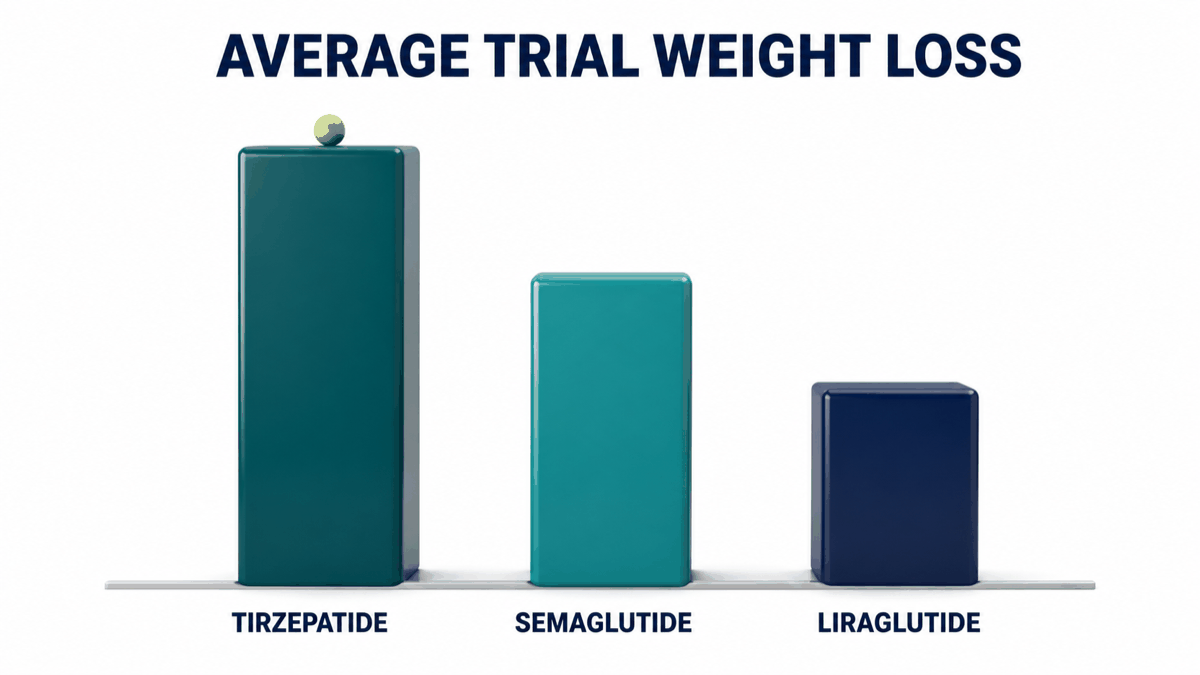
| Zepbound | Tirzepatide | Weekly | Approved for chronic weight management | 15.0%, 19.5% and 20.9% at 5, 10 and 15 mg over 72 weeks [1] |
| Wegovy | Semaglutide 2.4 mg | Weekly | Approved for chronic weight management | 14.9% vs 2.4% on placebo at 68 weeks [2] |
| Saxenda | Liraglutide 3.0 mg | Daily | Approved for chronic weight management | About 8% vs 2.6% on placebo at 56 weeks [4] |
| Mounjaro | Tirzepatide | Weekly | Approved for type 2 diabetes, off-label for weight | Same molecule as Zepbound, different indication |
| Ozempic | Semaglutide 1.0 or 2.0 mg | Weekly | Approved for type 2 diabetes, off-label for weight | Same molecule as Wegovy at lower doses |
| Retatrutide | Triple receptor agonist | Weekly | Investigational, not approved | About 24% at 48 weeks at the highest dose in phase 2 [7] |
| Lipotropic or B12 shots | Vitamins and amino acids | Weekly or more often | Not approved for weight loss | No randomized evidence of weight loss |
| HCG injections | Human chorionic gonadotropin | Daily | Not approved for weight loss | FDA states it is not effective for weight loss [8] |
If you want the wider injectable field in one place, including the compounded and research-grade products that sit outside the approved list, this catalog of weight loss injections collects them in a single view. Just keep the categories separate in your head, because a product being available is not the same as a product being studied.
Two comparisons in that table deserve emphasis because they are direct rather than inferred. SURMOUNT-5 put tirzepatide against semaglutide at maximum tolerated doses in the same trial and reported 20.2 percent versus 13.7 percent at 72 weeks [3]. STEP 8 put semaglutide 2.4 mg against liraglutide 3.0 mg and reported 15.8 percent versus 6.4 percent at 68 weeks [5]. The ranking among the three approved injections is not an artifact of comparing separate trials with different populations. It has been tested head to head twice.
How to read a weight loss injection number
Advertised numbers are technically true and practically misleading more often than they are wrong. Five questions turn a headline percentage back into something you can use.
Percent or pounds? Trials report mean percent change from baseline. Twenty percent means something different at 400 pounds than at 200. A pound figure without a starting weight is not comparable to anything.
Which analysis? The same trial can report a treatment-policy estimate, which counts everyone as randomized including people who stopped the drug, and an efficacy estimate, which counts people while they were actually taking it. The second is always the larger number. Marketing tends to quote the second and label it the result.
Over how long? The approved injections were studied over 56 to 72 weeks, and the weight curve is still shallowly declining at the end of most of them. A result quoted at 12 weeks is a titration snapshot, not an outcome.
Against what? Placebo arms in these trials still lost weight, between roughly 2 and 3 percent, because every participant received lifestyle counseling. The drug effect is the gap, not the total.
At what dose, and did people stay on it? The 20.9 percent figure in SURMOUNT-1 belongs to the 15 mg maintenance dose reached after months of escalation [1]. Someone who stalls at a lower dose because of side effects or cost should expect that lower dose's number.
What the injections do beyond the scale
Weight is the headline, and for two of these drugs it is not the only endpoint that has been tested.
Semaglutide 2.4 mg produced a 20 percent relative reduction in major adverse cardiovascular events in SELECT, a trial of more than 17,000 adults with established cardiovascular disease and overweight or obesity but no diabetes [6]. That result is the reason a cardiologist may favor semaglutide even though tirzepatide produces more weight loss.
Tirzepatide holds an indication for moderate to severe obstructive sleep apnea in adults with obesity, which no other obesity drug had before it. Liraglutide, the weakest of the three on weight, is approved down to age 12 for adolescents meeting the criteria, and its daily dosing means it clears faster if it needs to be stopped.
All three share the class side effect profile: nausea, vomiting, diarrhea, and constipation, concentrated during dose escalation and dose-dependent. Our page on GLP-1 side effects covers the full list, and how weight loss injections work explains the mechanism behind both the appetite effect and the gut symptoms.
The injections with no weight loss evidence
Two categories get sold alongside the approved drugs and do not belong in the same conversation.
HCG injections have been marketed for weight loss for decades, usually paired with a severe calorie restriction. The FDA states that HCG is not effective for weight loss and that over-the-counter HCG weight loss products are unapproved and illegal [8]. Any weight lost on an HCG protocol is attributable to the very low calorie diet it is bundled with.
Lipotropic injections, often sold as MIC shots or B12 shots, typically contain methionine, inositol, choline, and vitamin B12. There is no randomized controlled evidence that they produce weight loss. Correcting a documented B12 deficiency is a legitimate medical goal in its own right, but it is not a weight intervention.
What determines your result more than the molecule
The trial averages hide a wide spread. Individual results in these studies ranged from no meaningful loss to well above the mean, and the variables that separated them are mostly not the choice of drug.
Reaching and staying at the maintenance dose is the strongest one. Trial results belong to the maintenance dose, and titration takes roughly four to five months on standard schedules.
Continuity is the second. These are chronic therapies. In studies that withdrew people from semaglutide, most of the lost weight returned over the following year, which is what would be expected for a drug that suppresses appetite only while it is present.
Protein intake and resistance training decide the composition of the loss. Rapid weight loss of any kind takes lean tissue along with fat. Two to four resistance sessions a week and adequate protein flatten that curve, and neither is specific to injections.
Cost planning decides whether you get to month twelve at all. The cost of these drugs varies by insurance coverage, whether a qualifying diagnosis is documented, savings card eligibility and its annual cap, and whether you are buying a pen or a manufacturer self-pay vial. Model the full year before starting rather than the introductory month.
Before your first injection: the checklist
Take this to the appointment.
- Confirm the diagnosis and indication. Which drug is being prescribed, under which approved indication, and is it on-label for you.
- Confirm the product and source. Brand pen, manufacturer self-pay vial, or compounded preparation, and which pharmacy dispenses it.
- Get the titration schedule in writing. Starting dose, escalation interval, and the maintenance dose you are aiming for.
- Agree a side effect plan. What to do about nausea, what constitutes a reason to hold a dose, and when to call.
- Ask about interactions. Insulin and sulfonylureas usually need dose reduction. Oral medications with narrow absorption windows may be affected by slowed gastric emptying.
- Screen the contraindications. Personal or family history of medullary thyroid carcinoma or MEN 2, prior pancreatitis, active gallbladder disease, severe gastroparesis, pregnancy or plans to conceive [10][11].
- Set a monitoring plan. Weight, blood pressure, and relevant labs at intervals your clinician sets.
- Model twelve months of cost. Including the dose you expect to reach, not the starting dose.
- Agree a stopping plan. What happens if coverage ends, if the side effects do not settle, or if you reach your goal.
Every item on that list is a question for the prescribing clinician. None of it is a substitute for that consultation, and self-prescribing an injectable in this class is not a reasonable risk. If you are checking eligibility first, who cannot take weight loss injections covers the exclusions in detail.
Common questions about weight loss injections
- Which weight loss injection works best?
- Tirzepatide (Zepbound) has produced the largest mean weight reduction, including 20.2 percent versus 13.7 percent for semaglutide in the SURMOUNT-5 head-to-head trial at 72 weeks. Semaglutide (Wegovy) is second and liraglutide (Saxenda) is well behind both.
- How many weight loss injections are FDA-approved?
- Three for chronic weight management: tirzepatide, semaglutide 2.4 mg, and liraglutide 3.0 mg. Other injectables containing the same molecules, such as Ozempic and Mounjaro, are approved for type 2 diabetes and used off-label for weight.
- How fast do weight loss injections work?
- Appetite usually changes within the first few weeks, but the trial-level results belong to the maintenance dose, which takes about four to five months to reach on standard titration schedules.
- Do weight loss injections work without diet changes?
- Everyone in these trials received lifestyle counseling alongside the drug, so the published results describe a drug plus diet and activity support, not a drug alone. The injections make eating less considerably easier, which is the practical mechanism.
- What happens when you stop weight loss injections?
- Appetite returns and weight typically comes back over the following months. Studies that withdrew participants from semaglutide showed most of the lost weight regained within about a year, which is why these are treated as long-term therapies.
- Are weekly injections better than daily ones?
- The weekly drugs in this class also happen to be the more effective ones, so the comparison is confounded, but weekly dosing is easier to adhere to for most people. Liraglutide is the daily option and produced less than half the weight loss of weekly semaglutide in a head-to-head trial.
- Do B12 or lipotropic injections cause weight loss?
- There is no randomized controlled evidence that lipotropic or B12 shots produce weight loss. Treating a documented B12 deficiency is a separate and legitimate clinical goal.
- Are HCG injections a legitimate weight loss treatment?
- No. The FDA states HCG is not effective for weight loss and that over-the-counter HCG weight loss products are illegal. The weight lost on HCG protocols comes from the severe calorie restriction they are paired with.
- Is retatrutide available as a weight loss injection?
- Not as an approved medicine. Retatrutide is investigational, with about 24 percent mean weight loss at 48 weeks at the highest dose in a phase 2 trial. Any product sold as retatrutide today is outside the FDA-approved supply.
- Do weight loss injections hurt?
- The needles used are short and fine, and most people describe the injection as a brief pinch or nothing at all. Injection site reactions are usually mild and self-limiting.
Bottom line
Among weight loss injections, the evidence ranking is settled and has been tested directly: tirzepatide first, semaglutide second, liraglutide third, with everything else either still in trials or unsupported. What is not settled for any individual is the dose they reach, the side effects they tolerate, and how long they can afford to continue, and those three variables move the outcome more than the choice between the top two drugs. Bring the checklist above to a prescribing clinician and decide it there.
References
- Jastreboff AM et al, Tirzepatide once weekly for the treatment of obesity, NEJM 2022 (SURMOUNT-1)
- Wilding JPH et al, Once-weekly semaglutide in adults with overweight or obesity, NEJM 2021 (STEP 1)
- Aronne LJ et al, Tirzepatide as compared with semaglutide for the treatment of obesity, NEJM 2025 (SURMOUNT-5)
- Pi-Sunyer X et al, A randomized, controlled trial of 3.0 mg of liraglutide in weight management, NEJM 2015 (SCALE)
- Rubino DM et al, Effect of weekly subcutaneous semaglutide vs daily liraglutide on body weight, JAMA 2022 (STEP 8)
- Lincoff AM et al, Semaglutide and cardiovascular outcomes in obesity without diabetes, NEJM 2023 (SELECT)
- Jastreboff AM et al, Triple-hormone-receptor agonist retatrutide for obesity, a phase 2 trial, NEJM 2023
- FDA, HCG diet products are illegal
- FDA, concerns with unapproved GLP-1 drugs used for weight loss
- Zepbound (tirzepatide) prescribing information, DailyMed
- Saxenda (liraglutide) prescribing information, DailyMed