GLP-3: What the Nickname Means and Which Drug It Is
Summary: GLP-3 is an informal nickname for retatrutide, an investigational once-weekly injection that targets the GLP-1, GIP and glucagon receptors; it is not an approved drug or a scientific class.
This content is for informational purposes only and is not medical advice. Always consult a qualified healthcare provider before starting, changing, or stopping any medication.
GLP-3 is not a real drug class or a new hormone. It is the informal nickname people use for retatrutide, Eli Lilly's investigational once-weekly injection that activates three hormone receptors (GLP-1, GIP and glucagon) at the same time.[1] Searches for "glp 3" and "glp-3 drug" almost always come from people who heard the name in a news story or on social media and want to know what it refers to. This page gives the plain answer, the evidence behind it, and the regulatory status as of November 2026.
What GLP-3 means
Most people already know "GLP-1" from semaglutide (Ozempic, Wegovy). Tirzepatide (Mounjaro, Zepbound) added a second target, GIP, and was quickly called a "dual agonist." Retatrutide adds a third target, glucagon. Media writers then did the obvious arithmetic: one target is GLP-1, two is GLP-1 plus GIP, so three must be "GLP-3."
That reasoning is neat but wrong. There is no established hormone called GLP-3, and no receptor with that name. Lilly itself describes the term as "a scientifically inaccurate label used informally in the media to describe triple hormone receptor agonists," and prefers "triple agonist."[1] If you see "GLP-3" on a clinic site, a supplement store or a social post, read it as "retatrutide, or something marketed as retatrutide."
| Nickname | What it usually refers to | Receptors targeted | Status |
|---|---|---|---|
| GLP-1 | Semaglutide, liraglutide | GLP-1 | Approved |
| "GLP-2" (dual) | Tirzepatide, informally | GLP-1 and GIP | Approved |
| "GLP-3" (triple) | Retatrutide | GLP-1, GIP and glucagon | Investigational, not approved |
Only "GLP-1" is a formal name. The other numbered nicknames are shorthand for how many receptors a drug hits. The real hormone GLP-2 is a separate gut peptide unrelated to weight-loss drugs, which is another reason the numbering misleads.
Why the third receptor matters
GLP-1 and GIP signalling reduce appetite and help the body handle glucose. Glucagon receptor activation is the new part. Glucagon is better known for raising blood sugar, but it is also thought to increase energy expenditure and reduce liver fat. The design bet behind a triple agonist is that you can add that effect on top of the appetite effect. For the longer explanation of the mechanism, see how retatrutide works, and for the basic profile of the molecule see what retatrutide is.
What the phase 2 trial showed
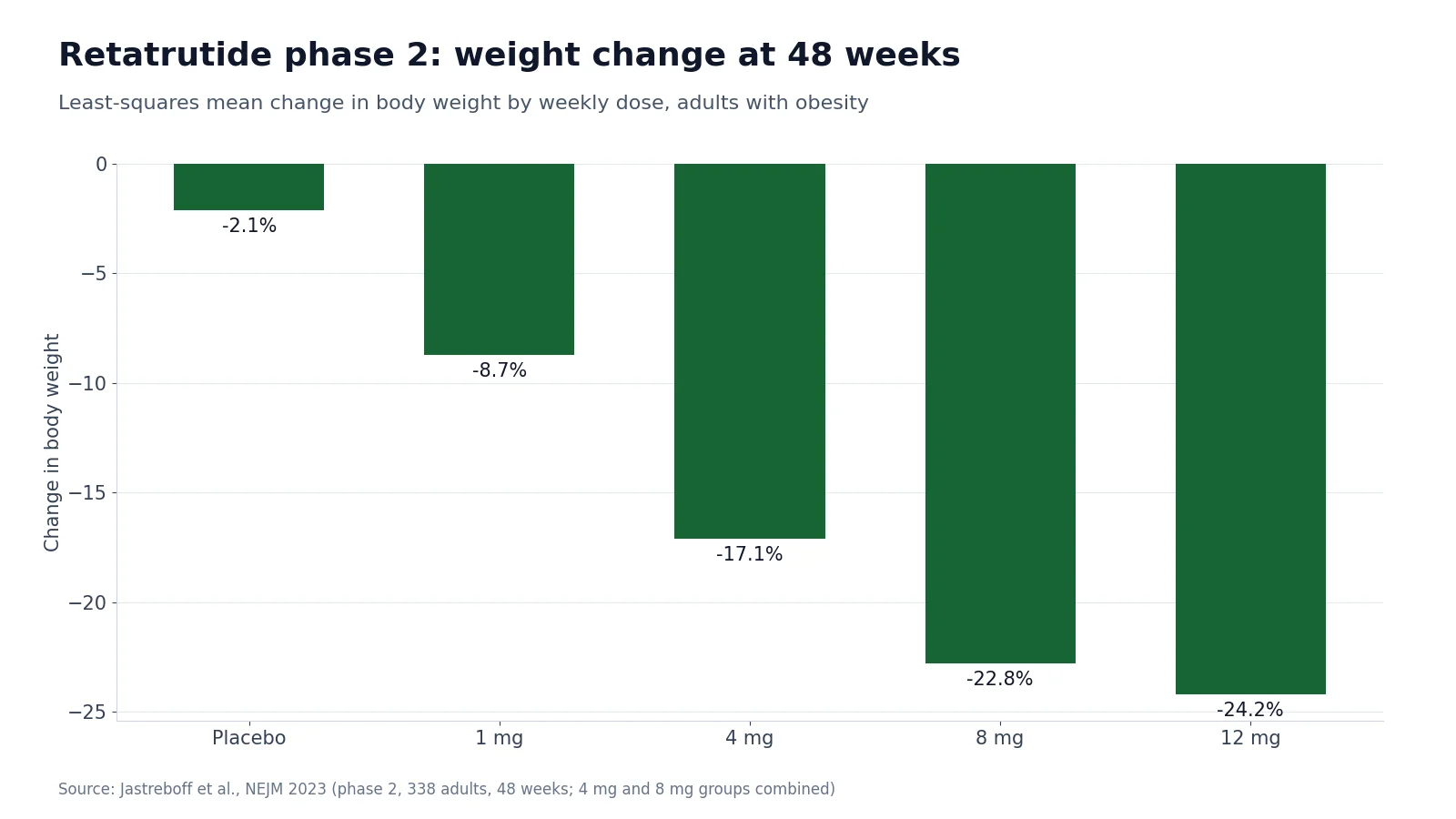
The numbers behind the hype come from a phase 2 trial in 338 adults with obesity or overweight, published in the New England Journal of Medicine in 2023.[2] Participants injected retatrutide or placebo once a week for 48 weeks. At 48 weeks the average body weight change was -8.7% on 1 mg, -17.1% on 4 mg, -22.8% on 8 mg and -24.2% on 12 mg, compared with -2.1% on placebo.[2] The most common side effects were gastrointestinal, and they were dose related.
For a dose-by-dose breakdown that goes beyond this overview, the site's retatrutide clinical trials page tracks each study.
Phase 3 results so far
Phase 2 was a mid-sized study. The larger test is the TRIUMPH phase 3 program, and several topline results are now public through Lilly announcements. "Topline" means the company has reported headline results; full peer-reviewed papers and regulatory review come later.
- TRIUMPH-1 (NCT05929066, announced 21 May 2026): 2,339 adults with obesity or overweight. At 80 weeks, average weight change was -19.0% on 4 mg, -25.9% on 9 mg and -28.3% on 12 mg, versus -2.2% on placebo. Discontinuation because of adverse events was 4.1%, 6.9% and 11.3% across those doses, versus 4.9% on placebo.[3]
- TRIUMPH-2 (announced 23 July 2026): 1,152 adults with obesity and type 2 diabetes. At 80 weeks, weight change was -12.7%, -19.1% and -20.8% on 4, 9 and 12 mg, versus -4.0% on placebo, with HbA1c falling by 1.4 to 1.6 points on retatrutide.[4]
- TRIUMPH-3 (announced 23 July 2026): 1,949 adults with a BMI of 35 or higher and established cardiovascular disease. Weight change was -21.6% on 9 mg and -22.6% on 12 mg, versus -3.2% on placebo. Diarrhea affected 30.1% (9 mg) and 24.4% (12 mg) of people, versus 8.7% on placebo, and 13.5% on 12 mg stopped treatment because of side effects, versus 4.8% on placebo.[4]
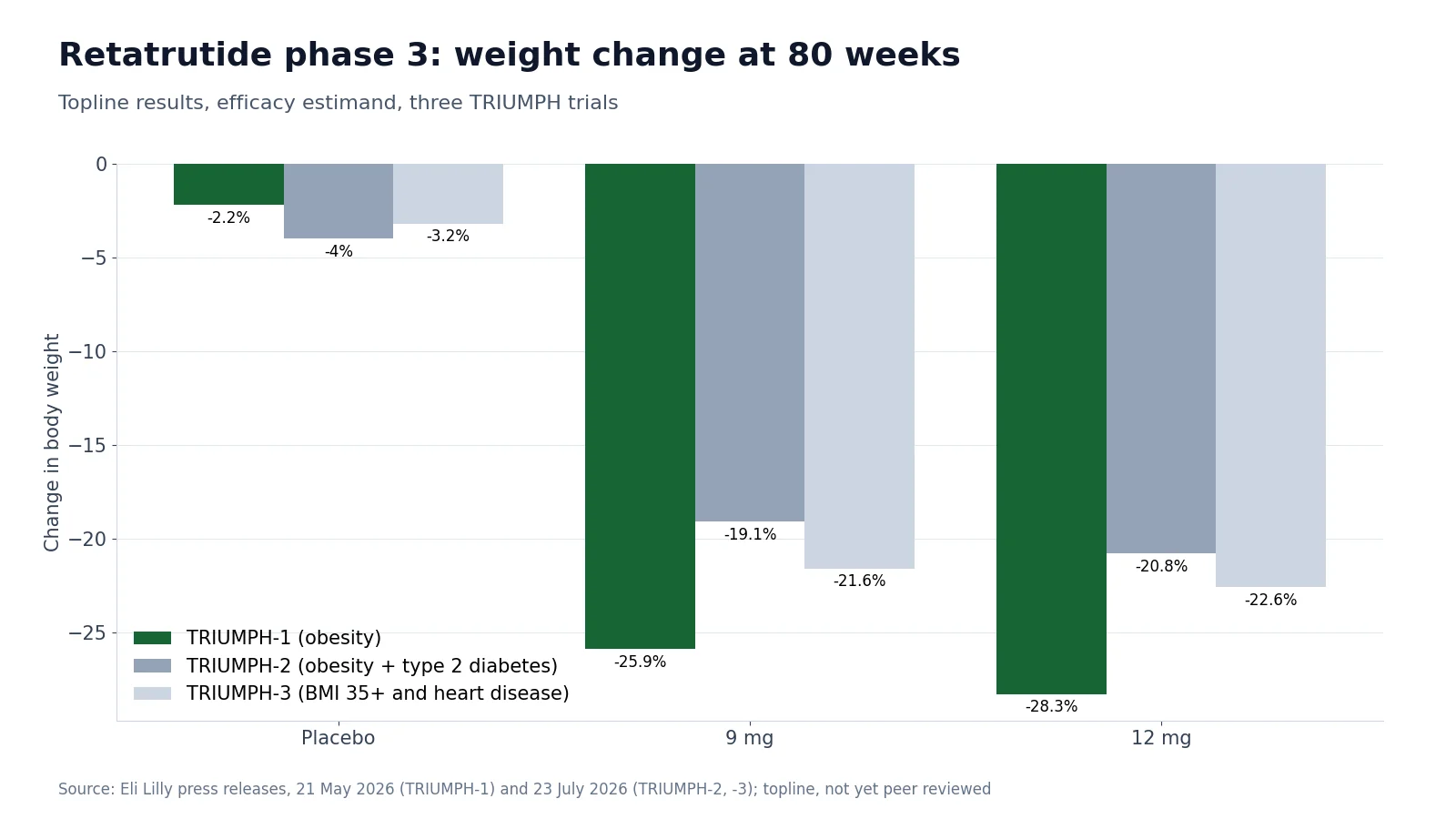
Two cautions apply. First, these are company-reported toplines, and the figures use a specific "efficacy estimand," which assumes people stayed on treatment. The TRIUMPH-1 release also reported lower treatment-regimen figures (for example -25.0% rather than -28.3% on 12 mg), which is the more conservative way to read it.[3] Second, the cardiovascular analyses in TRIUMPH-3 were described as underpowered and not definitive, so they do not show a proven heart benefit.[4] For tolerability in everyday terms, see the retatrutide side effects guide.
Is GLP-3 FDA approved?
No. Lilly states that retatrutide "has not been reviewed or approved by the FDA or any regulatory agency in the world."[1] As of 5 November 2026 there is no FDA approval and no public announcement that a submission has been filed. Lilly has said it plans to submit a Biologics License Application in the first quarter of 2027, after completing its manufacturing and quality package, and to seek global submissions for obesity, knee osteoarthritis pain and obstructive sleep apnea.[4] Review typically takes many months, so approval, if it comes, would be well after the filing. There is also no brand name yet.
This is the main way retatrutide differs from the drugs people compare it to. Semaglutide and tirzepatide reach patients through prescriptions, pharmacies and manufacturer savings programs. Retatrutide has no equivalent route today outside a clinical trial, which is why you will see so many sellers using the "GLP-3" label to attract searches.
Retatrutide compared with the approved GLP-1 drugs
| Question | Semaglutide | Tirzepatide | Retatrutide ("GLP-3") |
|---|---|---|---|
| Receptors | GLP-1 | GLP-1, GIP | GLP-1, GIP, glucagon |
| Dosing | Weekly injection | Weekly injection | Weekly injection |
| Prescription route in the US | Yes | Yes | None (investigational) |
| Evidence base | Approved label | Approved label | Phase 2 and phase 3 toplines |
Head-to-head trial data against the approved drugs is limited, so direct comparisons across separate trials should be treated with care. The reasoning and the numbers are laid out in retatrutide vs tirzepatide.
What to do if a seller offers "GLP-3"
Because there is no approved product, anything sold as GLP-3 or retatrutide is outside the normal drug supply chain. Lilly warns that illicit products may contain unknown ingredients, contaminants or the wrong amount of active ingredient.[1] If you are weighing a research-grade product anyway, the questions that matter are whether an independent lab report exists for the specific batch, whether the seller states what it is and is not, and whether anyone qualified is monitoring your health. A source-comparison walkthrough such as Middleway Nutrition's guide on where to buy retatrutide covers those checks in one place. None of this makes the product approved, and none of it is medical advice; if you want a GLP-1 medicine now, the approved options are the route with a prescriber and a regulator behind them.
FAQ
- What is GLP-3?
- GLP-3 is an informal nickname for retatrutide, a once-weekly injection in development by Eli Lilly that activates the GLP-1, GIP and glucagon receptors. It is not a hormone, a receptor or a formal drug class.
- Is the GLP-3 drug approved by the FDA?
- No. Retatrutide is investigational and has not been approved by the FDA or any other regulator. Lilly has said it plans to file with the FDA in the first quarter of 2027.
- Is GLP-3 the same as a triple agonist?
- Yes, in everyday usage. "Triple agonist" is the accurate term for a drug that activates three receptors, and it is the wording Lilly prefers over "GLP-3."
- How much weight did people lose on GLP-3?
- In the phase 2 trial, up to 24.2% of body weight at 48 weeks on 12 mg. In the TRIUMPH-1 phase 3 topline, up to 28.3% at 80 weeks on 12 mg, versus 2.2% on placebo. Results vary by trial population.
- Is GLP-3 better than semaglutide or tirzepatide?
- Reported weight loss is larger in retatrutide trials, but they are separate studies with different populations and designs, and retatrutide has no approved label or long-term safety record yet. Compare cautiously.
- Can I get GLP-3 with a prescription?
- Not as an approved medicine. The only legitimate access today is through a clinical trial.
References
- Eli Lilly, What to know about retatrutide (including 'What is a GLP-3?' and FDA status)
- Jastreboff AM et al, Triple-Hormone-Receptor Agonist Retatrutide for Obesity, A Phase 2 Trial, NEJM 2023;389:514-526
- Eli Lilly press release, 21 May 2026: retatrutide TRIUMPH-1 topline results (NCT05929066)
- HCPLive, Retatrutide Meets Phase 3 Weight-Loss Endpoints in 2 Obesity Trials, 23 July 2026 (TRIUMPH-2, TRIUMPH-3, BLA plan)