Peptides for Dogs: What Is Approved, and What Is Not
Summary: Some peptide medicines for dogs are FDA approved and a veterinarian can prescribe them today, while the compounds sold as research chemicals sit outside every pathway the law describes.
This content is for informational purposes only and is not medical advice. Always consult a qualified healthcare provider before starting, changing, or stopping any medication.
Peptides for dogs are two different subjects sharing one name, and most pages on the topic answer the wrong one. There are peptide medicines that veterinarians prescribe for dogs routinely, under a label, from a pharmacy. And there are vials of powder sold online to anyone with a card. Treating those as one category is how a careful owner ends up injecting an animal with something nobody has evaluated.
This page keeps them apart: which peptides are genuinely approved for dogs, what the lawful route to one looks like, and why there is not a single dosing figure below.
Peptides for dogs already exist, and some of them are FDA approved
A peptide is a short chain of amino acids. That definition is broad enough to cover a medicine sitting in refrigerators in veterinary practices across the country: insulin.
Insulin is a peptide hormone, and insulin for dogs is an approved veterinary medicine. Vetsulin, a porcine insulin zinc suspension from Merck Animal Health, is described by its manufacturer as the first FDA-approved insulin for use in dogs and cats with diabetes [4]. A dog with diabetes mellitus is treated with a peptide drug, on a reviewed label, dispensed against a veterinarian's instruction. That is ordinary medicine rather than anything experimental.
So the sentence you will read on a hundred blog posts, that peptides are not approved for dogs, is false. The accurate version is more useful anyway: some peptide medicines are approved for dogs, and none of the compounds sold on research-peptide websites are among them.
You do not have to take that on trust. FDA runs a public database of approved animal drugs, Animal Drugs @ FDA. Anything genuinely approved for dogs has a record in it. BPC-157, thymosin beta-4 and the rest do not.
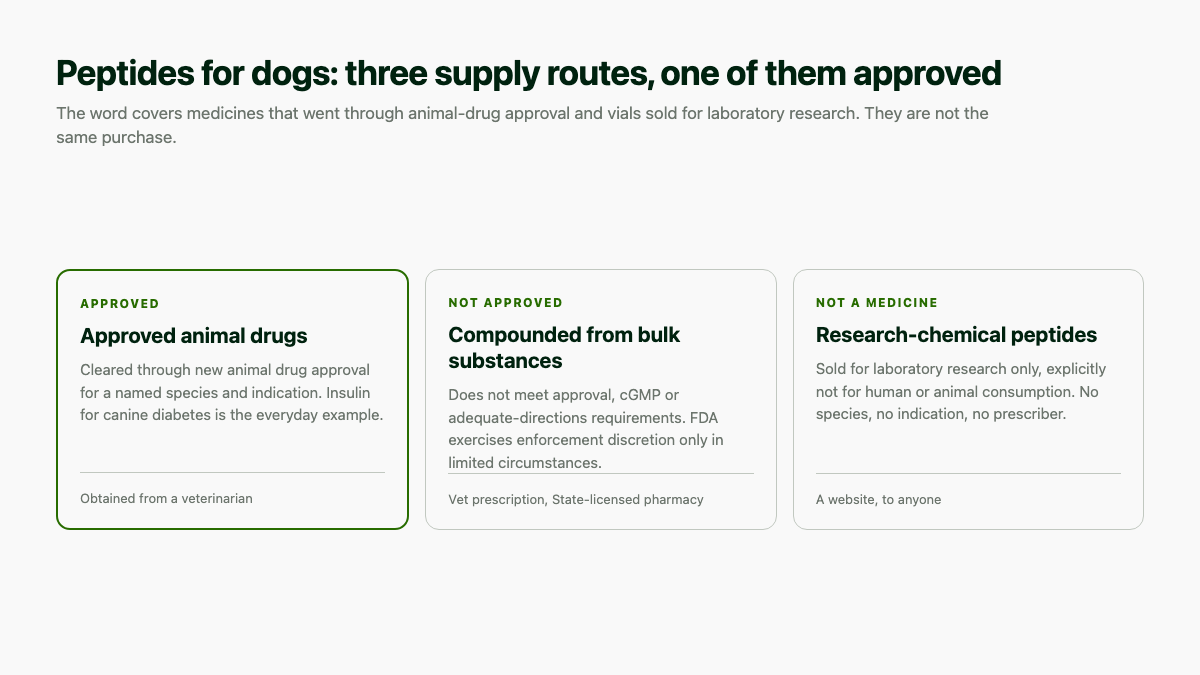
The three places a vial can come from
Most of the confusion dissolves once you can see three supply routes rather than one, and see that they are not three grades of the same thing.
| Route | What it is | How it reaches you |
|---|---|---|
| Approved animal drugs | Went through FDA new animal drug approval, with a reviewed label and directions for use. Insulin for canine diabetes is the everyday example | Your veterinarian, or a pharmacy filling their prescription |
| Compounded from bulk drug substances | Not approved. FDA exercises enforcement discretion in limited and documented circumstances | A veterinarian's patient-specific prescription, filled by a State-licensed pharmacy |
| Research-chemical peptides | Sold under a laboratory-research-only label, explicitly not for human or animal consumption | A website, to anyone, with no clinician involved at any point |
Marketing copy blurs the second and third rows together, because the second is real and the third would like to borrow its legitimacy. They are not close. The difference is a veterinarian who has examined your dog.
The lawful route runs through a veterinarian, not a checkout
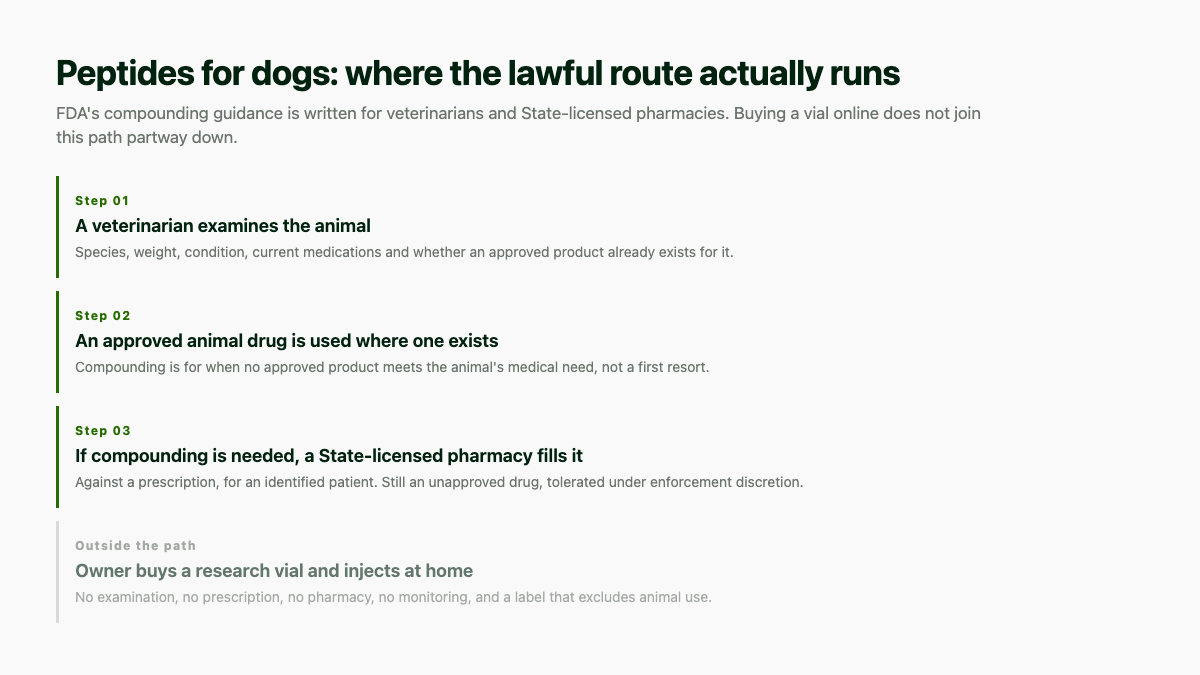
FDA's Center for Veterinary Medicine states its position in Guidance for Industry #256, Compounding Animal Drugs from Bulk Drug Substances, docket FDA-2018-D-4533. The central sentence is this:
Two details matter more to an owner than the quote itself.
The first is who the guidance is written for. FDA states it is intended for veterinarians, State-licensed pharmacies and Federal facilities [1]. It is not addressed to owners. Someone ordering a vial from a peptide site is not standing at the edge of that pathway with paperwork missing; they are not on it. The discretion FDA describes attaches to a veterinarian with an established veterinarian-client-patient relationship, who writes a prescription identifying the specific animal and supplies a medical rationale the pharmacist documents and keeps on file [3]. Take the veterinarian out and none of it is left standing.
The second is the phrase "under certain circumstances". FDA frames this as its position at this time, based on its current understanding of the risks [1]. That is conditional and revocable, not approval.
Compounding itself is normal veterinary practice. FDA notes that the FD&C Act permits compounding of animal drugs when the active ingredient comes from a finished FDA-approved drug rather than a bulk drug substance [2]. Turning an approved tablet into a flavoured liquid a dog will swallow starts from something FDA has already evaluated. The unapproved version starts from raw bulk powder, a distinction that also runs through human medicine, which this site covers under compounded versus brand-name medicines.
What the evidence on research peptides in dogs actually contains
BPC-157 is the compound most owners arrive asking about, usually after reading about a soft tissue injury healing faster or a gut problem settling.
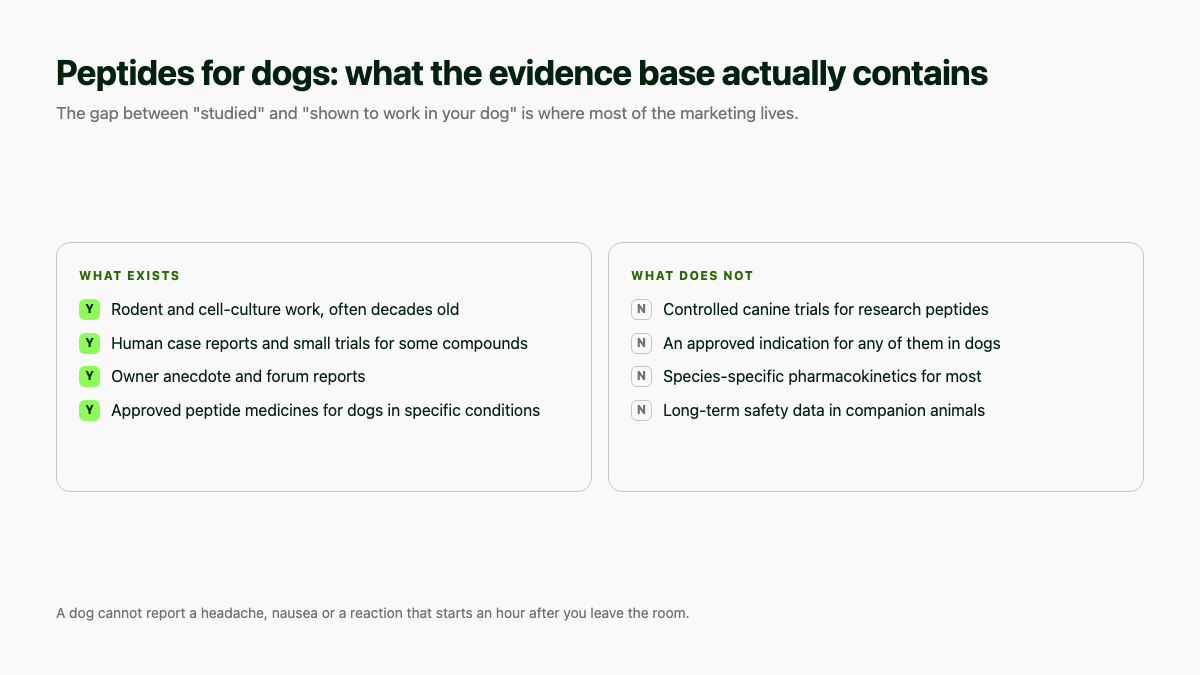
The honest state of it: the supporting literature is overwhelmingly rodent and in vitro work, much of it from a single research group, and no controlled canine trial exists that would establish an indication in dogs. There is no approved veterinary product containing it. On the human side there is not even a prescribable product to point at, because as we cover in detail, BPC-157 has no prescription anyone can write.
What fills the gap is anecdote: owner reports, forum threads, the clinical impressions of individual practitioners. That is a fair signal of where to look and a poor substitute for evidence of effect, and it is weakest in animals, because less pain and better mood are exactly what an owner reads into a dog being watched more closely than usual.
The second trap is extrapolation. Evidence generated in humans does not transfer to dogs. Species differ in absorption, clearance, receptor distribution and tolerance, which is why veterinary approval is a separate process rather than a rubber stamp on the human one. And the difference that matters most is not pharmacological. A person who feels wrong can say so in minutes. A dog cannot, so the signal usually has to become severe enough to be visible from across a room before anyone notices.
If you want the fuller compound-by-compound treatment, PeptideDeck's reference page on peptides for dogs, including BPC-157 and what the research shows goes deeper into the individual molecules than one page here can. Read it as background, and hold on to one thing: a figure printed on any website, ours or anyone else's, is not a veterinary dose for your animal.
The label on the vial is the real problem
Research-chemical peptides carry a legend saying they are laboratory material, not for human or animal consumption. That is not a lawyer's tic. It accurately describes what has and has not been done to the contents, and it is why no part of that supply chain owes you anything.
FDA's guidance Q&A records that on 23 July 2019 three horses died after receiving a compounded drug containing approximately twenty times the active ingredient stated on its label, and that a separate incident killed 21 horses [3]. Those failures happened at licensed compounding pharmacies: inspected businesses with names and professional registrations. A research-chemical vendor sits another step removed.
Certificates of analysis are the usual reassurance, and they are worth reading rather than treating as a badge. A certificate describes one batch, tested against a stated specification, on a stated date. What no certificate establishes is that the compound does anything in a dog, that the vial you were shipped is the batch on the document, or that anything stayed sterile after a needle went through the stopper at home. We go through how to read one in our guide to judging a BPC-157 supplier on public evidence.
Sterility and endotoxin carry more weight here, not less. The patient is smaller, cannot report the first hour of a reaction, and is being injected in a kitchen rather than a clinic.
There is also a quieter structural gap. FDA notes that while sponsors of approved animal drugs must report adverse events and product defects regularly, animal drug compounders face no such requirement, so safety problems can go undetected [3]. That is the licensed end of the unapproved market. A vendor shipping research material has no reporting duty at all, and no obligation to tell the next customer what happened to your dog.
Why there are no dosing figures on this page
This is deliberate rather than an oversight. No approved label exists for any of these compounds in dogs, so there is no dose to quote, and scaling a number by bodyweight is arithmetic rather than medicine: it knows nothing about a dog's kidneys, liver, diagnosis or other medications, and nothing about whether the vial contains what the label claims. A number on a page becomes a number in a syringe, and the animal cannot consent, refuse, or describe what happens next.
What to ask a veterinarian instead
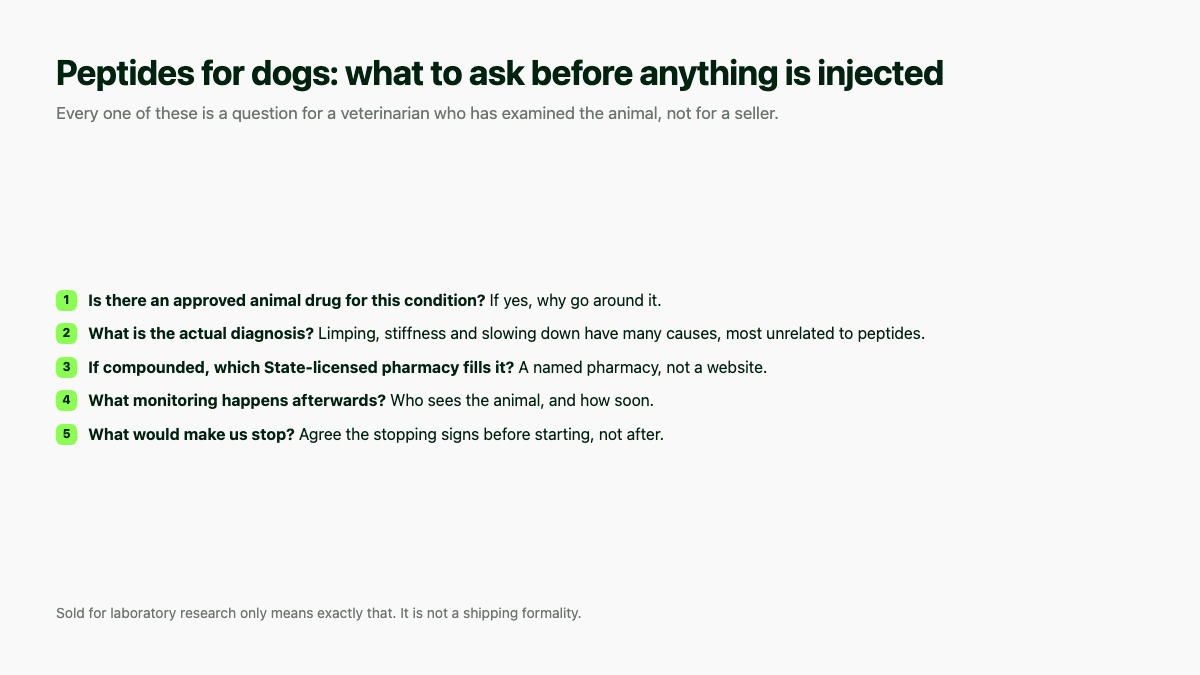
If a peptide is on your mind because something is wrong with your dog, take the underlying problem to a veterinarian and bring these questions.
- Is there an approved product for this problem in dogs? Ask it first. Approved options exist for a great many conditions and get skipped for being unglamorous.
- If not, is a compounded option appropriate, and would it start from an approved drug or from a bulk substance? Those are different levels of assurance.
- What is the evidence in dogs specifically? Not in rats, not in humans, not in testimonials. Very little is a useful answer, not a dead end.
- What would we monitor, and what would tell us to stop? Anything worth starting has a stopping rule attached.
- What is the plan if this does not work? A treatment with no next step is a hope rather than a plan.
If your dog has already been given something and you are worried, call your veterinarian, keep the vial and its label, and say plainly what was administered. Withholding it does not protect you and it does slow the diagnosis. Veterinarians, owners and caretakers can report problems with any drug to FDA using Form 1932a [5].
Common questions about peptides for dogs
- Are any peptides approved for dogs?
- Yes. Insulin is a peptide, and Vetsulin, a porcine insulin zinc suspension from Merck Animal Health, is described by its manufacturer as the first FDA-approved insulin for use in dogs and cats with diabetes. You can check any product yourself in FDA's Animal Drugs @ FDA database.
- Is BPC-157 approved for dogs?
- No. There is no approved veterinary product containing BPC-157 for any species, and no approved human product either. The research behind it is overwhelmingly rodent and in vitro, and no controlled canine trial supports an indication in dogs.
- Can my vet prescribe a peptide that is not FDA approved?
- In limited and documented circumstances, yes. FDA's enforcement discretion policy for drugs compounded from bulk substances requires a veterinarian with an established relationship with your dog, a prescription identifying that animal, a documented medical rationale, and a State-licensed pharmacy to fill it. That is a conversation with your vet, not a purchase online.
- How much would I give my dog?
- This page publishes no figure, and that is the answer rather than an omission. No approved label exists for these compounds in dogs, so no dose exists to quote, and any number you find elsewhere knows nothing about your particular dog. It has to come from a veterinarian who has examined the animal.
- Is it legal for me to buy a research peptide and give it to my dog?
- The material is sold under a laboratory-research-only label that explicitly excludes animal use, so giving it to a dog is outside the terms you agreed to at checkout and outside the compounding pathway FDA describes, which runs through a veterinarian and a licensed pharmacy. It also means no product liability, no adverse event reporting, and no recourse if the vial is not what the label says.
- My dog already had a dose. What should I do?
- Call your veterinarian, keep the vial and its label so the contents and batch can be identified, and say exactly what was given and when. If your dog is unwell, treat it as urgent. You can also report it to FDA using Form 1932a, which is open to owners as well as veterinarians.
The short version
Peptides for dogs are not one category. Approved peptide medicines for dogs exist, insulin being the everyday example, and they reach your dog through a veterinarian. A narrower compounding route exists where no suitable approved product is available, and FDA tolerates it only where a vet has examined the patient, written a patient-specific prescription and documented why. Research-chemical peptides are not a cheaper version of either. They sit outside both, carry a label that excludes animal use, come with no reporting duty and no recourse, and rest on an evidence base containing no controlled canine trials. The route to a peptide your dog might actually benefit from starts with an examination, and no version of it starts with a checkout.
References
- FDA, CVM GFI #256, Compounding Animal Drugs from Bulk Drug Substances, docket FDA-2018-D-4533, Center for Veterinary Medicine
- FDA, Animal Drug Compounding, Center for Veterinary Medicine
- FDA, Q&A: GFI #256, Compounding Animal Drugs from Bulk Drug Substances, updated 27 August 2024
- Merck Animal Health, Vetsulin (porcine insulin zinc suspension) product information for pet owners
- FDA, How to Report Animal Drug and Device Side Effects and Product Problems