FLGR-242 Review: What It Actually Is, and Discount Code
Summary: A recombinant follistatin construct sold as a research chemical, with three things the product listing does not resolve: what it binds, where its certificate is, and why every paper cited under its name studies something else.
This content is for informational purposes only and is not medical advice. Always consult a qualified healthcare provider before starting, changing, or stopping any medication.
FLGR-242 is a recombinant follistatin protein carrying an albumin binder, described by its seller as roughly 40 kDa, sold as a research chemical at $499.00 for a pair of 5 mg vials. It is not a short synthetic peptide, and it is not follistatin-344, although it is built from it.
That sentence is most of what a first-time reader needs, and it already puts this page ahead of the listings that call the compound a peptide and leave it there. One spelling note before anything else: the vendor writes the name FLGR242, with no hyphen, so searches for FLGR-242, FLGR 242 and FLGR242 all land on the same single product. The rest of this article covers what the construct is, what the product page says about it that cannot all be true at once, and what you are actually buying when the certificate of analysis is promised rather than published.
Where readers actually buy it
Bio Longevity Labs: FLGR242
The listing sells FLGR-242 as a pair of two 5 mg vials, 10 mg in total. Price and pack sizes checked on 8 September 2026.
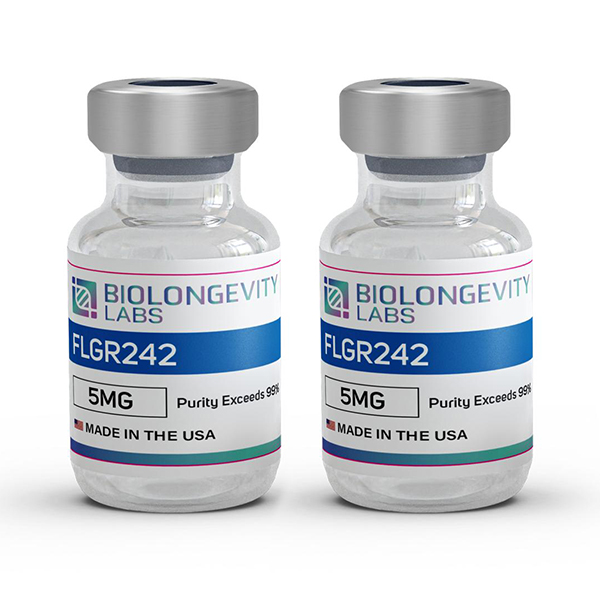
$499.00 is the list price for one pair and is the figure to plan around. Volume tiers take 5% off at 6 pairs, 10% at 12, 15% at 24 and 20% at 48, where the largest pack runs to $19,161.60 at list. A sitewide sale was running when we checked and showed $249.50 for a pair, but a sale is temporary and this page is not, so treat anything under list as a bonus rather than the price.
- 5 mg per vial, sold in pairs
- Vendor-stated US GMP manufacture
- Follistatin albumin construct, around 40 kDa
Sold for laboratory research only and not for human consumption. FLGR-242 is not an approved medicine in any market, no marketing authorisation exists for it anywhere, and it has never been tested in a human trial. No certificate of analysis covering this product appears in the vendor's public COA library. These are affiliate links: we may earn a commission at no cost to you, and it does not change what we report. Price checked September 8, 2026.
What FLGR-242 actually is
The product page describes the molecule in its own words [1]:
FLGR242 is a novel fragmented, modified version of Follistatin-344 (FST-344) that does not bind to the protein activin. [...] It also contains a patented albumin binder. Follistatin protein (FST) fused with an albumin-binding construct that uses a hydrophilic glycine-serine linker to achieve high-affinity binding to serum albumin (<20 nM Kd).
Set out as a table, the vendor-stated properties look like this.
| Vendor-stated property | Value |
|---|---|
| Type | Follistatin albumin binding construct |
| Linker sequence | GGSGGSGGSGGRLIEDICLPRWGCLWEDD |
| Molecular weight | Around 40 kDa |
| Albumin binding affinity | Under 20 nM Kd |
| Synonyms the vendor gives | FST-Albumin Construct, Extended Half-Life Follistatin |
| Vial size | 5 mg, sold as pairs of two vials, 10 mg total |
| Manufacturing claim | US GMP, third-party verified |
Forty kilodaltons is the number that reframes everything else on the page. Compounds sold in this market are usually short synthetic chains put together on a machine, and they weigh a small fraction of that. A 40 kDa molecule is a recombinant glycoprotein, grown in cells rather than assembled residue by residue, and it belongs to a different manufacturing category with different failure modes: folding, glycosylation, aggregation and host-cell residue are all live questions for a protein of this size and none of them exist for a nine-residue peptide. Almost every page selling this product calls it an FLGR-242 peptide and moves on. The word is doing real damage there, because it tells a buyer to apply the wrong quality checklist.
The albumin binder is the second design decision, and the vendor's own alternative name for the product, Extended Half-Life Follistatin, states the intent plainly. Binding tightly to serum albumin is a well-established way of keeping a protein in circulation longer. Whether this particular construct achieves it, in any organism, is not something the listing shows you, because no measurement of the finished molecule is published anywhere.
FLGR-242 vs follistatin-344, and why the distinction is not cosmetic
The vendor names follistatin-344 as the parent and then describes FLGR242 as a fragmented and modified version of it with an albumin-binding construct attached. Those are three separate changes stacked on one molecule: material removed, material altered, material added.
A protein that has been fragmented, modified and fused is a new entity. It is not the parent molecule with a longer half-life, and its behaviour cannot be read off the parent's. This matters more here than it would elsewhere, because the entire promotional case for the product, including the twelve papers cited on the listing, rests on follistatin research that studied the parent rather than the construct. Anyone searching FLGR 242 vs follistatin 344 is asking a fair question, and the honest answer is that nobody has published a comparison, in any system, at any scale.
The activin contradiction on the vendor's own page
This is the single strangest thing about the listing, and it sits in plain view. The same product page says three incompatible things about what FLGR-242 binds [1]:
- The product description states that it "does not bind to the protein activin".
- The meta description and social card say it is "Studied for myostatin inhibition and activin binding."
- The research applications section on the same page lists "activin neutralisation assays".
These cannot all be right. Follistatin's established mechanism is high-affinity binding and neutralisation of activins and related TGF-beta ligands. That is the thing follistatin is known for. A follistatin-derived construct that genuinely did not bind activin would be a substantially different molecule with a substantially different purpose, and yet the same page recommends buying it in order to run activin neutralisation assays.
There are two possible readings. Either the description is wrong and the construct binds activin like the protein it came from, or the description is right and the suggested application is wrong. A buyer cannot tell which from the listing, and neither can we. What can be said is that the property most relevant to what this molecule is for is stated in three ways on one page, and no data is offered that would settle it.
The COA is advertised but not published
The listing title says COA Included and the description promises comprehensive certificates of analysis. The vendor also maintains a public COA library, which is the right thing to have.
That library holds eight PDFs, and not one of them covers follistatin or FLGR242 [2]. The documents there are for Cortagen, plus endotoxin reports for BPC-157 and TB-500, CJC-1295 and ipamorelin, DSIP, retatrutide, SS-31 and tesamorelin. All useful, none of them this product.
A certificate that arrives after purchase is not the same instrument as one you can read beforehand. The whole function of a published COA is to let a buyer check identity, purity and contamination before money changes hands, which is precisely the moment at which the information has value. For a recombinant protein the case is stronger again, since the analytical panel that would be meaningful here is broader than the purity number a synthetic peptide certificate reports. Ask for the certificate for the specific lot before ordering, and read what tests it actually contains rather than counting the fact that a document exists.
What the papers cited under the FLGR-242 name actually studied
Searching for the compound name returns nothing:
- PubMed, for both FLGR-242 and FLGR242: zero results.
- ClinicalTrials.gov: zero records.
The product page does cite twelve papers, and we checked a sample of them. They are genuine, published and real: systemic administration of follistatin288 increasing muscle mass in mice [3], nanoparticle-mediated hepatic delivery of follistatin mRNA in mice [4], and follistatin in non-alcoholic fatty liver disease acting through mTOR [5]. Good papers, largely in animals.
None of them studied FLGR-242. Every one of them studied follistatin, or a specific isoform of it, or the gene that encodes it. Presenting that body of work beneath a product name is how a proprietary construct borrows the evidence base of the protein family it derives from, and it is very effective, because a reader who clicks through finds real science at the other end. The step that never happened is the one where somebody tested this molecule and wrote up the result.
So the accurate position on FLGR 242 recombinant follistatin is that the underlying protein has a genuine research literature, that the literature is mostly in mice, and that the product itself has none at all.
Why there is no FLGR-242 dosage section on this page
FLGR-242 dosage is a common search and this article does not answer it. That is deliberate rather than an oversight.
There is no human data on this construct. No trial has been registered, none has been run, and no result has been published. A dosing figure requires a study that established one, and in the absence of that study any number circulating online was either extrapolated from mouse work on a different molecule or invented. Publishing either would give the number a legitimacy it has not earned. The same applies to reconstitution volumes and administration schedules, which are the parts of a protocol that look most authoritative and rest on the least here.
FLGR-242 for sale: the review verdict at $499 a pair
Stripped down, the decision looks like this. You are buying a recombinant protein of around 40 kDa, from a vendor whose page contradicts itself about the property that defines the molecule, whose certificate for this product is not published where the others are, and for which no independent literature exists under its own name. Against that, the construct is a coherent piece of design, the vendor is transparent about the linker sequence and the binding affinity, and the follistatin science it draws on is real.
For a laboratory that intends to characterise the material itself, none of the above is disqualifying, and the price at $499.00 a pair is what it is. For anyone treating the listing as a summary of established facts about the compound, the gap between what the page implies and what has been demonstrated is very wide. Ask for the lot certificate first.
Questions about FLGR-242
- Is FLGR-242 a peptide?
- Not in any useful sense. The vendor gives a molecular weight of around 40 kDa, which puts it in recombinant protein territory rather than the short synthetic chains the word peptide normally describes on a research chemical site. It is a follistatin albumin fusion construct, and the difference changes which quality questions are worth asking.
- Why do I find FLGR-242 spelled three different ways?
- The vendor spells it FLGR242 with no hyphen on the product page itself, while search demand is split across FLGR-242, FLGR 242 and FLGR242. They all refer to the same single product, so the spelling tells you nothing about the source.
- Is FLGR-242 the same as follistatin-344?
- No. The vendor describes it as a fragmented and modified version of follistatin-344 with an albumin-binding construct attached, which is three changes to the parent molecule. No published comparison of the two exists.
- What does the discount code do?
- Peptidedeck is entered at checkout on the vendor's site. We have not verified what it returns, so we do not state a percentage, and you should read the total before confirming the order rather than trusting any figure quoted on a page like this one.
- Are there any human results for FLGR-242?
- None. PubMed and ClinicalTrials.gov both return zero for the name. The papers cited on the listing are real follistatin studies, largely in mice, and none of them tested this construct.
- Can I see a certificate of analysis before buying?
- Not from the public library, which holds eight PDFs and none for this product. The listing promises certificates with the order, so if pre-purchase verification matters to you, request the certificate for the specific lot and check what tests it contains before you commit.
References
- Bio Longevity Labs, FLGR242 5mg Research Peptide product listing (accessed 8 September 2026)
- Bio Longevity Labs, public certificate of analysis library (accessed 8 September 2026)
- Systemic administration of follistatin288 increases muscle mass, 2013, mice (PMID 23942549)
- Nanoparticle-mediated hepatic delivery of follistatin mRNA, 2018, mice (PMID 30555546)
- Follistatin in non-alcoholic fatty liver disease via mTOR, 2022 (PMID 36325432)